SMRs and AMRs

Wednesday, March 28, 2012

Yo, suburbanites: Think your life is comfortable? Think twice ...

U.S. Suburbs Face Twin Perils of Climate Change and Peak Oil

Sprawling metropolitan areas like Merriam, Kans., face fundamental challenges from global warming and the end of easy oil


By Maggie Koerth-Baker  | Friday, March 23, 2012
Scientific American

Editor's note: The following is an excerpt from Before the Lights Go Out: Conquering the Energy Crisis Before It Conquers Us (John Wiley & Sons, 2012), by Maggie Koerth-Baker.

Most people reading this would probably find Merriam, Kansas, very familiar. Not because they've been there, but because it's a lot like home.

Merriam is usually described as a suburb of Kansas City, Kans.—a small town that grew into a residential center for people who worked in the much larger city nearby. Yet the mental images that go with the word suburb don't really fit Merriam all that well. When I think suburb, I imagine something like Levittown, treeless insta-villages where rows of identical houses dot gleaming new cul-de-sacs recently carved out of some farmer's field. The greater Kansas City area certainly has its share of developments that would fit that description, but Merriam isn't one of them.

In fact, when I was a kid, I didn't even know Merriam existed at all. I thought it was Kansas City. Specifically, I thought it was where Kansas City began, the distinct point where you exit the Interstate and find yourself in the big city. This particular misconception has more to do with my family's regular travel plans than anything else—Merriam's main drag happens to be the same road that leads to the art museum my dad and I went to a lot and to the Christmas light displays I visited every winter with my mom. It also speaks volumes about what Merriam actually looks like, though, and it's tied to some important trends in the way most Americans live today.

Merriam isn't a small town. There's nothing really recognizable as a small town central business district. Instead, Merriam's stores and offices are mostly concentrated along two major thoroughfares—Shawnee Mission Parkway and Johnson Drive. These wide, multilane roads are dotted with clusters of shopping centers and big box stores, like necklaces strung with fat pearls. The municipal building and the police station are a couple of nondescript offices that sit off the frontage of Shawnee Mission Parkway, on a ridge overlooking the Interstate. Nothing about that says, "Classic Americana."

(More here.)

Labels: ,

Tuesday, February 28, 2012

Climate change will shake the Earth

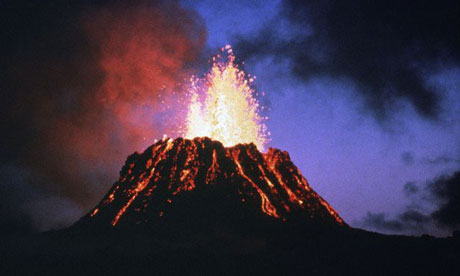
As the Earth's crust buckles, volcanic activity will increase. Photograph: Corbis

A changing climate isn't just about floods, droughts and heatwaves. It brings erupting volcanoes and catastrophic earthquakes too.

Bill McGuire
guardian.co.uk, Sunday 26 February 2012 14.59 EST

The idea that a changing climate can persuade the ground to shake, volcanoes to rumble and tsunamis to crash on to unsuspecting coastlines seems, at first, to be bordering on the insane. How can what happens in the thin envelope of gas that shrouds and protects our world possibly influence the potentially Earth-shattering processes that operate deep beneath the surface? The fact that it does reflects a failure of our imagination and a limited understanding of the manner in which the different physical components of our planet – the atmosphere, the oceans, and the solid Earth, or geosphere – intertwine and interact.

If we think about climate change at all, most of us do so in a very simplistic way: so, the weather might get a bit warmer; floods and droughts may become more of a problem and sea levels will slowly creep upwards. Evidence reveals, however, that our planet is an almost unimaginably complicated beast, which reacts to a dramatically changing climate in all manner of different ways; a few – like the aforementioned – straightforward and predictable; some surprising and others downright implausible. Into the latter category fall the manifold responses of the geosphere.

The world we inhabit has an outer rind that is extraordinarily sensitive to change. While the Earth's crust may seem safe and secure, the geological calamities that happen with alarming regularity confirm that this is not the case. Here in the UK, we only have to go back a couple years to April 2010, when the word on everyone's lips was Eyjafjallajökull – the ice-covered Icelandic volcano that brought UK and European air traffic to a grinding halt. Less than a year ago, our planet's ability to shock and awe headed the news once again as the east coast of Japan was bludgeoned by a cataclysmic combination of megaquake and tsunami, resulting – at a quarter of a trillion dollars or so – in the biggest natural-catastrophe bill ever.

(More here.)

Labels:

Monday, February 20, 2012

The Big Con

by Tom Maertens

(An expurgated version of this ran in the Mankato Free Press, Feb. 20.)

Thomas Mann, of the bipartisan Brookings Institution, and Norman Ornstein, of the conservative American Enterprise Institute have written that, “One of our two major parties, the Republican, has become an insurgent outlier—ideologically extreme … and unpersuaded by conventional understanding of facts, evidence and science.”

They could have been writing about Rudy Boschwitz’s recent op-ed denying global warming (Mankato Free Press, Feb. 11) which didn’t cite a single reputable scientific organization to support his claim. Instead, he trotted out the thoroughly discredited S. Fred Singer, a “rent-a-scientist” spokesman for the tobacco industry paid to deny the effects of second hand smoke, which the Surgeon General has found responsible for up to 61,000 American deaths every year.

Singer and the carbon industry-funded lobby are using the tobacco play-book again in arguing against science: “Doubt is our product,” and “The jury is still out.” As of 2007, Singer was affiliated with 11 groups that received funding from ExxonMobil, and has acknowledged serving as a consultant for Exxon, Texaco, Arco, Shell, Sun, Unocal, and others.

Boschwitz quotes Singer on past climate cycles, which are not in dispute, but fails to consider the future consequences of injecting 36 billion tons of carbon dioxide (plus other gases) into the atmosphere every year. Only about 1% of that escapes into outer space. The remaining CO2 creates the greenhouse effect and global warming. That’s why 2010 was the warmest year on record.

Boschwitz cites petitionproject.org as a source for his claims. That site asserts that it has over 31,000 signatories, and that all of them “have formal educations in fields of specialization that suitably qualify them to evaluate the research data” related to global warming. It provides no verifiable information about signatories, and according to the AP, has included such names as the cast of the TV program MASH.

The project claims that 12,715 people with B.S. or equivalent degrees have signed the petition. In other words, any elementary teacher with a B.S. in education is qualified to evaluate climate research data. Really?

Another one-third of the signers are engineers, not usually considered experts on climate science; likewise with the veterinarians, “general scientists,” foresters, and others cited by petitionproject.

This is what junk science looks like. If you don’t have experts, you tout the people you do have as experts, including “over 9,000 PhD’s,” all unverified, in something or other.

Moreover, many signatures were apparently obtained under false pretenses. The original “Oregon Petition" was sent out as a mass mailing -- designed to look like an official communication from the National Academy of Sciences -- by Arthur Robinson of the Oregon Institute of Science and Medicine (OISM), an organization that Greenpeace says is supported by ExxonMobil. The NAS responded, saying it had nothing to do with the petition which “does not reflect the conclusions of expert reports of the Academy." The Union of Concerned Scientists called the petition “a deliberate attempt to mislead scientists.”

Another of Boschwitz’s spurious claims is that global warming was worse during the Medieval Warming and Roman Warming periods, suggesting he doesn’t understand his own source, which specifies “Northern Hemisphere” right in the title. Other parts of the world were colder than average at the same time, as a 2009 study by Michael Mann of PennState showed, resulting in temperatures “well below recent levels globally."

Another favorite red-herring of the deniers, which Boschwitz parrots, is that scientists are in it for the money…”billions” he says. Indeed there is money being made in the climate business but it goes to lobbyists and deniers like Senator James Inhofe who con the American people on behalf of Big Oil and Coal. They perpetrate their anti-science hoax so that their corporatist allies don’t have to reduce pollution or CO2 emissions. The carbon industry pockets the profits and sticks us with the pollution. That saves the Koch brothers billions, which they spread around to profiteers like Inhofe; they are his biggest campaign contributors, according to OpenSecrets.org.

The deniers’ Big Con also stokes up the lunatic fringe, the ones who send death threats to scientists and their families, as Michael Mann has reported.

Boschwitz himself is a big-time money bundler and a registered lobbyist, which raises the question of whether he is being paid to repeat the Big Con. A prominent government watchdog, Craig Holman of Public Citizen, wrote last year that, “(Boschwitz’s) primary objective in setting up (t)his lobbying consulting firm is to avoid disclosure and to avoid lobbying ethics rules … which raises “serious questions.”

Yes, doesn’t it.

Labels:

Sunday, February 19, 2012

Climate change denial: Where political belief supersedes science

by Leigh Pomeroy
Published in the Mankato Free Press
Saturday, February 18, 2012

MANKATO — Several years ago while deplaning a flight from Colorado I was approached by a distinguished older gentleman who happened to have been sitting in the row behind me. “I found your discussion very interesting,” he said.

I had been talking politics with a seatmate, likewise a stranger, and we had come to a consensus on a number of issues. “In what way?” I asked the distinguished gentleman, expecting perhaps some dissent.

“Oh, I agree with much of what you said,” he replied. In looking at him further I thought, oh my God, this is someone I know but I’ve forgotten his name. I delicately pushed him as to who he was and eventually, somewhat reluctantly, he said he was Rudy Boschwitz.

Flashback two days earlier to one of the reasons I was in Colorado: for a college reunion. I was listening to a presentation by a former roommate who is now the foremost researcher on climate change in the Amazon River basin.

A transplanted American now living in Manaus, Brazil, Dr. Philip Fearnside was soberly and quite emphatically demonstrating to us with charts, figures and data that unless Amazon rainforest destruction and climate change were reversed, the whole South American continent would be in deep doodoo. Hot, dry deep doodoo.

Which brings me to Sen. Boschwitz’s recent op-ed piece in The Free Press — a recounting, unfortunately, of the standard smorgasbord of arguments oft repeated ad nauseam by right-wing pundits and well-paid shills for the fossil fuel industry. Boschwitz’s opening salvo in the article is that “31,487 American Scientists including 9,029 with Ph.D’s” (Google hits for this precise wording: 132) have signed a petition denying global warming.

This claim has been debunked numerous times since the petition was first floated in 1997 by or in such sources as Scientific American, the Sierra Club, the Union of Concerned Scientists, the Seattle Times and the highly regarded and objective website realclimate.org.

From this assertion his article gets sillier, sighting some of the same deniers (e.g. Fred Singer) who have gained fame — and sometimes fortune — from their minority positions.

There is no argument that the planet has gone through many warming and cooling periods in its history, as Sen. Boschwitz asserts. Despite the huge complexity of the subject, climate scientists are beginning to understand what causes these fluctuations and, perhaps more importantly, what they cannot predict ... yet.

One thing they do understand is that, given the predictable cyclical causes of climate change, the planet should not be warming as fast as it is. In fact, there is evidence that it should be cooling.

“What’s causing this warming then?” they have asked. The conclusion by the overwhelming majority of scientists who really study climate — not weather, which is short term — is reminiscent of the famous old Pogo cartoon: “We have met the enemy and he is us.”

This is why Sen. Boschwitz’s piece is so disappointing. Hopefully in the future his reading list will include more books and articles by true climate scientists instead of by those who make their living creating doubt.
_________________________

Below is a suggested reading list for Sen. Boschwitz:
Books about climate science cover-up:
U.S. government sources:

Department of Defense and National Security:
National Oceanographic and Atmospheric Administration:
NASA:

Labels:

Wednesday, February 15, 2012

Big donors — some anonymous — fund climate change deniers

Leak exposes how Heartland Institute works to undermine climate science

Libertarian thinktank keeps prominent sceptics on its payroll and relies on millions in funding from carbon industry, papers suggest

by Suzanne Goldenberg, US environment correspondent
guardian.co.uk, Tuesday 14 February

The inner workings of a libertarian thinktank working to discredit the established science on climate change have been exposed by a leak of confidential documents detailing its strategy and fundraising networks.

DeSmogBlog, which broke the story, said it had received the confidential documents from an "insider" at the Heartland Institute, which is based in Chicago. The blog monitors industry efforts to discredit climate science.

The scheme includes spending $100,000 on commissioning an alternative curriculum for schoolchildren that will cast doubt on global warming.

It was not possible to immediately verify the authenticity of the documents. "There is nothing I can tell you," Jim Lakely, Heartland's communications director, said in a telephone interview. "We are investigating what we have seen on the internet and we will have more to say in the morning." Lakely made no attempt to deny the veracity of information contained in the documents.

The Heartland Institute, founded in 1984, has built a reputation over the years for providing a forum for climate change sceptics. But it is especially known for hosting a series of lavish conferences of climate science doubters at expensive hotels at New York's Time Square as well as in Washington DC.

(Continued here.)

Labels:

Thursday, February 02, 2012

Climate change: Wall Street Journal (again) tells it like it isn't

Remarkable Editorial Bias on Climate Science at the Wall Street Journal

by Peter Gleick
Forbes

The Wall Street Journal’s editorial board has long been understood to be not only antagonistic to the facts of climate science, but hostile. But in a remarkable example of their unabashed bias, on Friday they published an opinion piece that not only repeats many of the flawed and misleading arguments about climate science, but purports to be of special significance because it was signed by 16 “scientists.”

Serious doubt has been cast on the actual expertise on climate science of the signers and on the accuracy of the content, here and elsewhere, and the strawman arguments and technical flaws of their opinion piece are evident to anyone actually versed in the scientific debate. For example, their op-ed has fundamental errors about recent actual temperatures, they use false/strawman arguments that climate scientists are saying climate change “will destroy civilization,” they launch ad hominem attack on particular climate scientists using out-of-context quotes, and so on. Formal responses are in the works, and will be available from a variety of groups in the next day or so. [Just as an example, as pointed out here previously, and at the Union of Concerned Scientists: the authors claim there has been a “lack of warming” for 10 years. The reality? 2011 was the 35th year in a row in which global temperatures were above the historical average and 2010 and 2005 were the warmest years on record.]

(Continued here.)

The Wall Street Journal op-ed in question: "No Need to Panic About Global Warming"

Article by 255 climate scientists that was rejected by the Wall Street Journal: "Climate Change and the Integrity of Science"

Other relevant articles:

"2011 Climate Change in Pictures and Data: Just the Facts"

"Wall Street Journal rapped over climate change stance"

"Wall Street Journal attacked over climate change denial"

Labels:

Sunday, December 25, 2011

Weather-wise, a northern California Christmas in Minnesota

Christmas Day 2011
Mankato, Minnesota

This morning I trotted out to pick up the paper in my bathrobe and slippers. Of course, there was no Free Press, being Christmas Day, which is fine with me as I'm a strong believer that paper carriers deserve a rest at least once a year. (My kids and I did our local Free Press route for a short while one winter when we were all younger. Just a couple of months was enough to realize it's a thankless job for very little pay.)

But the point is that I was in my bathrobe and slippers. On Christmas Day. In Minnesota.

And yesterday, Christmas Eve day, I was doing yard work. Not the shoveling snow kind. The raking leaves and moving brush kind. In shirtsleeves. No jacket.

In fact, this Christmas reminds me of the Christmases I enjoyed in northern California growing up: Sunny with mild temperatures. And of course no snow.

Is there something a bit odd here?

And then I came across this article from the New York Times that Tom Maertens had posted on Vox Verax. It reminds me of all the work we have to do in the coming years to make up for the past century or so of our American expectation that everyday should be Christmas.

That thought aside, I do wish all our Vox Verax readers a very pleasant Christmas day spent with family and friends.

Leigh Pomeroy

Labels: ,

Monday, July 25, 2011

Damn the deniers, full speed ahead!

The Navy Wants You... To Be Energy Efficient

Posted by Ross Pomeroy at Thu, 21 Jul 2011
Newton Blog

Despite the charged American political climate that now envelops the issue of global climate change, the United States Navy is now boldly moving forward with plans to reduce their massive consumption of energy and foreign oil through a project called Task Force Climate Change. The service branch views energy independence and climate change as matters of national security. Imagine that!

Because the Navy doesn't have the luxury of professing a political opinion, it is required to make rational decisions based on a plethora of objective information. Thus, through Task Force Climate Change, a branch of the Navy's Energy and Environmental Readiness Division, the Navy has made the following conclusions about global climate change after considering "a broad consensus of observational evidence and historical trends:"
  • The Arctic is losing sea ice.
  • Large land-fast ice sheets (particularly in Greenland and Antarctic) are steadily losing ice mass.
  • Global air and sea temperatures are warming.
  • Sea level is rising in certain areas.
  • Precipitation patterns are changing.
In response to Navy Scientists' carefully considered conclusions and out of a desire to promote the cause of energy security, Rear Admiral Phil Cullom has likened the current situation to our original war for independence.

(Continued here, including links.)

Labels: , , ,

Wednesday, June 22, 2011

Can science and the truth withstand the merchants of poison?

"Here is the truth: The Earth is round; Saddam Hussein did not attack us on 9/11; Elvis is dead; Obama was born in the United States; and the climate crisis is real. It is time to act."

Climate of Denial

Al Gore
Rolling Stone

The first time I remember hearing the question "is it real?" was when I went as a young boy to see a traveling show put on by "professional wrestlers" one summer evening in the gym of the Forks River Elementary School in Elmwood, Tennessee.

The evidence that it was real was palpable: "They're really hurting each other! That's real blood! Look a'there! They can't fake that!" On the other hand, there was clearly a script (or in today's language, a "narrative"), with good guys to cheer and bad guys to boo.

But the most unusual and in some ways most interesting character in these dramas was the referee: Whenever the bad guy committed a gross and obvious violation of the "rules" — such as they were — like using a metal folding chair to smack the good guy in the head, the referee always seemed to be preoccupied with one of the cornermen, or looking the other way. Yet whenever the good guy — after absorbing more abuse and unfairness than any reasonable person could tolerate — committed the slightest infraction, the referee was all over him. The answer to the question "Is it real?" seemed connected to the question of whether the referee was somehow confused about his role: Was he too an entertainer?

That is pretty much the role now being played by most of the news media in refereeing the current wrestling match over whether global warming is "real," and whether it has any connection to the constant dumping of 90 million tons of heat-trapping emissions into the Earth's thin shell of atmosphere every 24 hours.

(More here.)

Labels: ,

Wednesday, June 15, 2011

Climate change future: More "Blowin' in the Wind"

(LP NOTE: I was traveling and missed this article when it first came out. It is timely only in the sense that it refers to the recent storms in the midsection of the country this spring. It is timeless in the sense that scientists have predicted an increase in these severe weather events as humankind's imprint on the climate grows.)

Valentina Abinanti / Polaris — Joplin, Missouri after the tornado that hit on May 22.

Are You Ready for More?

In a world of climate change, freak storms are the new normal. Why we’re unprepared for the harrowing future.

by Sharon Begley
Newsweek
May 29, 2011

Joplin, Mo., was prepared. The tornado warning system gave residents 24 minutes’ notice that a twister was bearing down on them. Doctors and nurses at St. John’s Regional Medical Center, who had practiced tornado drills for years, moved fast, getting patients away from windows, closing blinds, and activating emergency generators. And yet more than 130 people died in Joplin, including four people at St. John’s, where the tornado sucked up the roof and left the building in ruins, like much of the shattered city.

Even those who deny the existence of global climate change are having trouble dismissing the evidence of the last year. In the U.S. alone, nearly 1,000 tornadoes have ripped across the heartland, killing more than 500 people and inflicting $9 billion in damage. The Midwest suffered the wettest April in 116 years, forcing the Mississippi to flood thousands of square miles, even as drought-plagued Texas suffered the driest month in a century. Worldwide, the litany of weather’s extremes has reached biblical proportions. The 2010 heat wave in Russia killed an estimated 15,000 people. Floods in Australia and Pakistan killed 2,000 and left large swaths of each country under water. A months-long drought in China has devastated millions of acres of farmland. And the temperature keeps rising: 2010 was the hottest year on earth since weather records began.

From these and other extreme-weather events, one lesson is sinking in with terrifying certainty. The stable climate of the last 12,000 years is gone. Which means you haven’t seen anything yet. And we are not prepared.

(Continued here.)

Labels: , ,

Tuesday, April 26, 2011

A totally renewable future: Is it possible?

(LP note: The article below is nearly a year and a half old. The goals it presents are ambitious but, as the authors argue, reachable. Do our collective governments have the political wisdom to pull it off? The answer depends upon whether you are an optimist or a pessimist.)

A Plan to Power 100 Percent of the Planet with Renewables

Wind, water and solar technologies can provide 100 percent of the world's energy, eliminating all fossil fuels. Here's how.

By Mark Z. Jacobson and Mark A. Delucchi
Scientific American  | Monday, October 26, 2009 | 166

Mark Z. Jacobson is professor of civil and environmental engineering at Stanford University and director of the Atmosphere/Energy Program there. Mark A. Delucchi is a research scientist at the Institute of Transportation Studies at the University of California, Davis.

In December leaders from around the world will meet in Copenhagen to try to agree on cutting back greenhouse gas emissions for decades to come. The most effective step to implement that goal would be a massive shift away from fossil fuels to clean, renewable energy sources. If leaders can have confidence that such a transformation is possible, they might commit to an historic agreement. We think they can.
A year ago former vice president Al Gore threw down a gauntlet: to repower America with 100 percent carbon-free electricity within 10 years. As the two of us started to evaluate the feasibility of such a change, we took on an even larger challenge: to determine how 100 percent of the world’s energy, for all purposes, could be supplied by wind, water and solar resources, by as early as 2030. Our plan is presented here.

Scientists have been building to this moment for at least a decade, analyzing various pieces of the challenge. Most recently, a 2009 Stanford University study ranked energy systems according to their impacts on global warming, pollution, water supply, land use, wildlife and other concerns. The very best options were wind, solar, geothermal, tidal and hydroelectric power—all of which are driven by wind, water or sunlight (referred to as WWS). Nuclear power, coal with carbon capture, and ethanol were all poorer options, as were oil and natural gas. The study also found that battery-electric vehicles and hydrogen fuel-cell vehicles recharged by WWS options would largely eliminate pollution from the transportation sector.

(Continued here.)

Labels: ,

Thursday, April 21, 2011

8 billion tons is really a lot of coal

You climate-change deniers could give a little

Article by: RANDY SKJERLY
Updated: April 20, 2011 - 9:25 PM
Minneapolis Star Tribune

OK, deniers: Let's just roll with your unshakable belief that carbon emissions aren't causing climate changes.

Glacier National Park, which once had 125 glaciers, now has 20. The pine bark beetle has edged into Yellowstone.

A shipping lane has opened through the Arctic. Storms keep getting bigger and more violent blah blah you've heard it all so let's set theory aside for things easy to Google.

Each of the 400 coal-fired plants around the United States emit an average of 366,000 tons of hazardous air pollutants per year -- mercury, arsenic, chromium, nickel, carbon monoxide and sulfur dioxide.

These fumes and particulates kill an estimated 15,000 U.S. citizens yearly from heart attacks, lung disease, cancer and asthma. Most bodies of water are so contaminated by mercury you'd scarcely dare eat fish from them.

I rolled with you on point A: Mankind's pollution may not be causing climate change.

Are you with me on point B: Smokestack exhausts are hazardous to humans and the ecosystem? Yes?

You remain, nonetheless, hostile to regulation aimed at curbing emissions. Most likely you fear your utility will pass along the cost, increasing your electric bill.

As well, you fear that if manufacturing plants pay more for electricity, they will pass the increased cost of goods on to you. That is why you call cap-and-trade "cap and tax."

(Continued here. This article was written in response to one entitled "Climate change is natural, and we don't have the data to predict it" by Jason Lewis, a nationally syndicated talk-show host based in Minneapolis-St. Paul.)

Labels: ,

Monday, April 04, 2011

National Geographic on Climate Change: The Acid Sea

The carbon dioxide we pump into the air is seeping into the oceans and slowly acidifying them. One hundred years from now, will oysters, mussels, and coral reefs survive?

By Elizabeth Kolbert
National Geographic

Castello Aragonese is a tiny island that rises straight out of the Tyrrhenian Sea like a tower. Seventeen miles west of Naples, it can be reached from the somewhat larger island of Ischia via a long, narrow stone bridge. The tourists who visit Castello Aragonese come to see what life was like in the past. They climb—or better yet, take the elevator—up to a massive castle, which houses a display of medieval torture instruments. The scientists who visit the island, by contrast, come to see what life will be like in the future.

Owing to a quirk of geology, the sea around Castello Aragonese provides a window onto the oceans of 2050 and beyond. Bubbles of CO2 rise from volcanic vents on the seafloor and dissolve to form carbonic acid. Carbonic acid is relatively weak; people drink it all the time in carbonated beverages. But if enough of it forms, it makes seawater corrosive. "When you get to the extremely high CO2, almost nothing can tolerate that," Jason Hall-Spencer, a marine biologist from Britain's University of Plymouth, explains. Castello Aragonese offers a natural analogue for an unnatural process: The acidification that has taken place off its shore is occurring more gradually across the world's oceans, as they absorb more and more of the carbon dioxide that's coming from tailpipes and smokestacks.

(Article here. Photos here.)

Labels: ,

Wednesday, March 16, 2011

Let's see: Does the Earth orbit around the sun or vice versa?

Republicans on House Energy Committee Deny Climate Change

Evan McMorris-Santoro
Talking Points Memo
March 15, 2011, 6:33PM

Thirty-one Republicans on the House Energy And Commerce Committee -- the entire Republican contingent on the panel -- declined on Tuesday to vote in support of the very idea that climate change exists.

Democrats on the panel had suggested three amendments that said climate change is a real thing, is caused by humans and has potentially dire consequences for the future. The amendments came on a Republican bill to block the EPA from offering regulations to mitigate the results of global climate shifts. The global scientific community is in near unanimous agreement that climate change is real, and that humans contribute to it.

None of the 31 Republicans on the committee would vote yes on any of the amendments. (Rep. Marsha Blackburn [R-TN] declined to vote on one.) The committee's 21 Democrats voted yes on all three.

Though the result may seem shocking to supporters of climate legislation, activists say this is pretty much what they expect from the GOP these days. There was a time when members of the mainstream GOP were ready to offer their own solutions to climate change. But in the tea party age, those Republicans are few and far between at best, observers say.

(More here.)

Labels: ,

Tuesday, March 01, 2011

Head of Australian Catholic Church among climate change deniers

Heavenly belief in science fiction

GRAHAM READFEARN
The Drum Unleashed
Australian Broadcasting Corporation

The director of Australia’s Bureau of Meteorology Dr Greg Ayers must surely possess the patience of a saint or, if you don’t believe in saints, then the patience of my wife who has been waiting for me to fix the hole in the bathroom ceiling for well over three years.

Dr Ayers has finally gained some closure on an issue concerning Cardinal George Pell, the head of the Catholic church in Australia who while believing in saints, doesn’t believe in human-caused climate change.

Dr Ayer’s unloaded his frustrations on a senate estimates committee this week, saying he believed Cardinal Pell had been “misled” by a book called Heaven and Earth, written by Australian climate sceptic and mining director Professor Ian Plimer. He then told the committee why.

Climate change sceptics/deniers/contrarians/unbelievers will no doubt be looking to mislead the Australian public even further in the coming months, now that a framework to establish a price on carbon – albeit with a still paltry five per cent cut in emissions – has been put before us by the Multi-Party Committee on Climate Change. Expect to see many of the already disproved arguments from the book dusted off and re-introduced.

(More here.)

Labels:

Saturday, February 26, 2011

'Eppure, si muove': Yes, Sen. Inhofe and Rep. Upton, the earth circles the sun, not the other way around

Climate Cranks Gin Up the Right Wing Noise Machine

Mark Hertsgaard, author, 'Hot: Living Through the Next Fifty Years on Earth'

The right-wing media machine is a large part of the reason why denial of climate change persists in the United States long after the rest of the world has acknowledged the problem. Over the past few days, I've gotten a close-up look at how the machine works, because I've been its target.

Last Tuesday, February 15, I went to Capitol Hill on a mission: to confront the climate cranks who still refuse to accept what virtually every major scientific organization in the world, starting with our own National Academy of Sciences, has concluded: man-made climate change is real, happening now and extremely dangerous.

I also wanted to highlight a fact I have often marveled at during my twenty years of writing about climate change in books and for leading publications around the world, including Vanity Fair, Time, The Nation and most recently Politico. That fact is: virtually every major political party in the world -- except for the Republicans in this country -- accepts this mainstream scientific conclusion.

Yet the average American would not know this is the case. Why not? Because discussion about climate change in the U.S. is dominated by how the issue is framed by politicians and the media in Washington. And inside the Beltway, denial of mainstream climate science is regarded as a legitimate opinion rather than as an unfounded oddity.

(More here. The Politico article he refers to is below.)

Climate change: GOP Galileo moment

By: Mark Hertsgaard
February 15, 2011
Politico

Will it take the Republican Party as long to accept modern science as it took the Roman Catholic Church? The church waited 359 years to admit Galileo was right — the earth does move around the sun. Not until 1992 did the Vatican officially withdraw its condemnation of the man Albert Einstein called the father of modern science.

Today, even children know that the earth revolves around the sun. But that idea was heresy to the 17th-century church. When Galileo would not abandon his views, the Inquisition put him on trial in 1633. He was forced to recant under penalty of death, then lived under house arrest for the rest of his life.

Now the House Republican majority is launching its own attack on Galileo’s scientific descendants. Rejecting mainstream climate science became a GOP litmus test during the 2010 midterm elections. Republican leaders then floated the idea of putting mainstream climate science on trial in congressional hearings.

This week, Rep. Fred Upton (R-Mich.), the chairman of the House Energy Committee, introduced legislation that would “repeal” the Environmental Protection Agency’s scientific determination that greenhouse gases threaten human health and welfare.

After Galileo reluctantly recanted, legend has it that he muttered, “Eppure, si muove” ["and yet it moves"]. In other words — censorship and repression could not change physical fact: The earth moves around the sun, whether the church agreed or not.

(Continued here.)

Labels: ,

Monday, February 07, 2011

Joke provokes Koch stroke

JANUARY 27, 2011
New York Times

Koch Industries Unamused by Climate Spoof

By TOM ZELLER JR.

Bloomberg — The conglomerate with interests in everything from oil refining to Dixie paper cups does not like having its trademark infringed by climate activists.

From the sometimes bizarre front lines of the climate-change culture wars: It seems the brothers Koch, proprietors of the giant, Kansas-based industrial conglomerate and well-heeled supporters of Tea Party causes, have now set their sights on a group of anonymous pranksters who spoofed a Koch Industries press release last month — one that suggested the brothers were having a change of heart on climate change.

The fake statement, which was posted online at a Web address similar to that of Koch Industries and circulated to members of the press, said the company was cutting off its support for a variety of groups openly skeptical of global warming science.

While it doesn’t appear that any media outlets were duped, Koch Industries — not widely known for indulging critics — quickly assembled its legal foot soldiers. The company filed a lawsuit in a federal district court in Utah late last month, charging a phalanx of anonymous “John Does” with “trademark infringement, cybersquatting, and unfair competition.”

From the complaint:
Koch brings this action to redress Defendants’ misappropriation of Koch’s intellectual property and impersonation of Koch for the purpose of deceiving the public and promoting Defendants’ agenda. Koch supports open and honest public discourse. Defendants’ impersonation of Koch and misappropriation of its intellectual property are antithetical to honest discourse because they deceive the public respecting Koch’s true position on Issues and respecting Defendant’s motives.
(More here. The fake press release is below:)
Koch Industries on Climate Science

Labels: ,

Friday, July 30, 2010

Michael E. Mann: In denial of warming, lies were repeated

Here's the context surrounding a flawed 2003 research paper

By MICHAEL E. MANN
StarTribune
July 30
The author is a professor of meteorology at Penn State University and is director of the Penn State Earth System Science Center.
In "Warming alarmists can't stand the heat" (July 26), the Star Tribune allowed Peter J. Havanac to do a grave disservice to its readers by making false statements about me and other climate scientists. 
Havanac repeated false allegations (based on illegally hacked e-mails) of supposed scientific misconduct by scientists at the Climatic Research Unit of the University of East Anglia (for example, the supposed destruction of e-mails) that have now been rejected as false by three separate investigations in the U.K. A similar investigation by my university has exonerated me of any of the wrongdoing alleged by climate-change deniers like Havanac. Unfortunately, these exonerations cannot stop individuals like Havanac from repeating the false allegations. Only the possession of decency can do that. 
Havanac parroted the false claim that I sought to "undermine" a journal that "contradicted views held by ... global-warming alarmists." His claim was based on a thorough misrepresentation of a single example: a deeply flawed paper published in 2003 by the journal Climate Research. That paper, by Willie Soon and Sallie Baliunas, claimed that recent warming is not unusual. 
I did in fact have concerns about the paper and the process that led to its publication. As the Wall Street Journal reported ("Global warming skeptics are facing storm clouds," July 31, 2003), this fossil-fuel-industry-funded study was heavily criticized by a large number of other scientists. The editor-in-chief of Climate Research, Hans Von Storch, found that the paper "was flawed" and "shouldn't have been published."
Original here. Interestingly enough, the overwhelming number of climate scientists are of one mind: They know that human-caused greenhouse gasses are warming the earth's atmosphere. Meteorologists, on the other hand, are not quite sure, with many, like Peter Havanac, allying themselves with the so-called climate change denier group, and others, like Mann, siding with the climate scientists.

Those climate scientists and meteorologists who understand the science of the greenhouse gas effect vary in their opinion of how serious that effect is. Some, like Richard Lindzen of MIT, a well-known so-called "denier", argues that the atmosphere is self-adjusting, and that all the efforts to limit greenhouse gas emissions will have little or no effect at a great cost to the world economy.

Others, like James Hansen of the NASA Goddard Institute for Space Studies, says that even a small increase in greenhouse gasses could tip the delicate weather balance through a falling domino effect that will result in disastrous worldwide climate changes unless humankind takes immediate steps to limit the release of those gasses.

For the record, we at Vox Verax, having studied the science as well as both sides of the issue, are more in the Hansen camp and feel that we need to act as if Hansen could be entirely correct. If we don't and Hansen is correct, the planet will look a lot different in the future than it does today ... and not for the better.

Labels: ,

Thursday, May 13, 2010

Stop attacking climate scientists, say 255 members of National Academy of Sciences

Science 7 May 2010:
Vol. 328. no. 5979, pp. 689 - 690


LETTERS

Climate Change and the Integrity of Science

We are deeply disturbed by the recent escalation of political assaults on scientists in general and on climate scientists in particular. All citizens should understand some basic scientific facts. There is always some uncertainty associated with scientific conclusions; science never absolutely proves anything. When someone says that society should wait until scientists are absolutely certain before taking any action, it is the same as saying society should never take action. For a problem as potentially catastrophic as climate change, taking no action poses a dangerous risk for our planet.

Scientific conclusions derive from an understanding of basic laws supported by laboratory experiments, observations of nature, and mathematical and computer modeling. Like all human beings, scientists make mistakes, but the scientific process is designed to find and correct them. This process is inherently adversarial—scientists build reputations and gain recognition not only for supporting conventional wisdom, but even more so for demonstrating that the scientific consensus is wrong and that there is a better explanation. That's what Galileo, Pasteur, Darwin, and Einstein did. But when some conclusions have been thoroughly and deeply tested, questioned, and examined, they gain the status of "well-established theories" and are often spoken of as "facts."

For instance, there is compelling scientific evidence that our planet is about 4.5 billion years old (the theory of the origin of Earth), that our universe was born from a single event about 14 billion years ago (the Big Bang theory), and that today's organisms evolved from ones living in the past (the theory of evolution). Even as these are overwhelmingly accepted by the scientific community, fame still awaits anyone who could show these theories to be wrong. Climate change now falls into this category: There is compelling, comprehensive, and consistent objective evidence that humans are changing the climate in ways that threaten our societies and the ecosystems on which we depend.

(Continued here. The same letter, adding the affiliations of the co-signers, is here.)

Labels: ,

Sunday, April 18, 2010

Still plenty of work to be done for Mother Earth

by Don Gordon, professor emeritus of botany at Minnesota State University, Mankato

Thursday will be the 40th anniversary of Earth Day, and for more than three decades I have been writing annual Earth Day columns to report on the environmental health of the planet. These columns are sobering reminders that we have met the enemy, and he is us.

From the time man first appeared, the planet has been largely viewed as a giant hardware store or as an unlimited free buffet where we could take what we wanted.

Along the way, we didn’t have to worry much about exhausting resources or polluting the planet. When a resource became scarce or an area became polluted, we simply looked elsewhere and moved to another area. That strategy worked pretty well until our population and appetite for resources started to grow exponentially.

In 1800, the planet supported about 1 billion people. Now there are nearly 7 billion, and the United Nations estimates there will be more than 9 billion of us by 2050. Further, there are now more than 1 billion poor people who are chronically undernourished, and the U.N. plan to reduce that number by 2015 will not be met.

Cereal grain growth has declined, and if the temperature increases just 2 degrees C. (3.6 degrees F.), this could lead to an additional 20 to 40 percent decline in cereal yields. To feed an extra 2.5 billion by 2050 will require the developed countries to increase production by 70 percent. Without that increase, there may be more than 2 billion chronically hungry people by 2050.

University of Minnesota environmentalist Jonathan Foley and eight others writing in Scientific American report that, just in the last 50 years, “the global consumption of food and fresh water has more than tripled, and fossil fuel use has risen fourfold.” Man now co-opts between 1 ⁄ 3 and 1 ⁄ 2 of all the photosynthesis on the planet.

The journal Worldwatch recently reported that, in 2006, man consumed $30.5 trillion worth of goods and services, up 28 percent from 10 years ago. We Americans use more than anyone else.

On average, each of us consumes about 194 pounds of resources daily.

If the whole world used resources at this rate, Worldwatch estimates the Earth could sustain only 1.4 billion people or just 1 ⁄ 5 of our current size.

Foley and his group set thresholds for key environmental processes that, if crossed, could threaten the sustainability of Earth.

Their analysis indicated that three thresholds have already been breached.

These include biodiversity loss, nitrogen pollution and climate change.

■ Biodiversity Loss. This rapid rate of consumption is also taking its toll on living organisms. To call attention to this loss, the United Nations has designated 2010 as the International Year of Biodiversity.

Julia Marton-Lefevre writing in a recent issue of the journal Science reports that global loss of biodiversity costs us between $1.35 and $3.1 trillion annually.

Loss of tropical forests is responsible for nearly 20 percent of greenhouse gas emissions; thus, it is a major force in climate change.

Biodiversity loss could cause land and ocean ecosystem failure.

Possible solutions would include slowing land clearing and development and eliminating the idea that nature is free.

They propose establishing a pay system for ecosystem services.

■ Nitrogen pollution. Unless checked, fresh water and ocean hypoxic dead zones will expand.

Possible solutions would include reducing fertilizer use, planting more winter cover crops, planting more perennials, processing animal waste and switching to hybrid vehicles.

■ Climate Change. There has been a lot of misinformation put out on climate change. For example, the claim that the Earth is cooling is bunk, according to NASA’s James Hanson.

Global warming has neither stopped nor slowed in the last decade.

The World Meteorological Organization reported that 2000-2009 was the hottest decade on record. Current carbon dioxide levels of 390 parts per million are the highest in recorded history. Foley’s group thinks 350 ppm was the threshold level.

Unless we mitigate climate change, polar ice and glaciers will melt and regional climates will shift. Possible solutions include switching to low- carbon energy and fuels and put ting a price on carbon emissions.

The environmental solutions proposed by Foley and his group might slow down environmental degradation of the planet, but according to the new book “Eaarth” by Bill McKibben, they might not solve the underlying cause, which is our insatiable quest for economic growth.

According to McKibben, our hope depends on scaling back — on building the kind of societies and economies that are sustainable. As you might guess, the critics have labeled his solutions as unrealistic.

Labels: , , ,