SMRs and AMRs

Friday, July 30, 2010

Michael E. Mann: In denial of warming, lies were repeated

Here's the context surrounding a flawed 2003 research paper

By MICHAEL E. MANN
StarTribune
July 30
The author is a professor of meteorology at Penn State University and is director of the Penn State Earth System Science Center.
In "Warming alarmists can't stand the heat" (July 26), the Star Tribune allowed Peter J. Havanac to do a grave disservice to its readers by making false statements about me and other climate scientists. 
Havanac repeated false allegations (based on illegally hacked e-mails) of supposed scientific misconduct by scientists at the Climatic Research Unit of the University of East Anglia (for example, the supposed destruction of e-mails) that have now been rejected as false by three separate investigations in the U.K. A similar investigation by my university has exonerated me of any of the wrongdoing alleged by climate-change deniers like Havanac. Unfortunately, these exonerations cannot stop individuals like Havanac from repeating the false allegations. Only the possession of decency can do that. 
Havanac parroted the false claim that I sought to "undermine" a journal that "contradicted views held by ... global-warming alarmists." His claim was based on a thorough misrepresentation of a single example: a deeply flawed paper published in 2003 by the journal Climate Research. That paper, by Willie Soon and Sallie Baliunas, claimed that recent warming is not unusual. 
I did in fact have concerns about the paper and the process that led to its publication. As the Wall Street Journal reported ("Global warming skeptics are facing storm clouds," July 31, 2003), this fossil-fuel-industry-funded study was heavily criticized by a large number of other scientists. The editor-in-chief of Climate Research, Hans Von Storch, found that the paper "was flawed" and "shouldn't have been published."
Original here. Interestingly enough, the overwhelming number of climate scientists are of one mind: They know that human-caused greenhouse gasses are warming the earth's atmosphere. Meteorologists, on the other hand, are not quite sure, with many, like Peter Havanac, allying themselves with the so-called climate change denier group, and others, like Mann, siding with the climate scientists.

Those climate scientists and meteorologists who understand the science of the greenhouse gas effect vary in their opinion of how serious that effect is. Some, like Richard Lindzen of MIT, a well-known so-called "denier", argues that the atmosphere is self-adjusting, and that all the efforts to limit greenhouse gas emissions will have little or no effect at a great cost to the world economy.

Others, like James Hansen of the NASA Goddard Institute for Space Studies, says that even a small increase in greenhouse gasses could tip the delicate weather balance through a falling domino effect that will result in disastrous worldwide climate changes unless humankind takes immediate steps to limit the release of those gasses.

For the record, we at Vox Verax, having studied the science as well as both sides of the issue, are more in the Hansen camp and feel that we need to act as if Hansen could be entirely correct. If we don't and Hansen is correct, the planet will look a lot different in the future than it does today ... and not for the better.

Labels: ,

Wednesday, February 17, 2010

Woods Hole team finds subtropical waters flushing through Greenland fjord

Woods Hole Oceanographic Institute

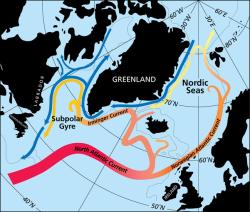
Recent changes in ocean circulation in the North Atlantic are delivering larger amounts of subtropical waters to the high latitudes. A research team led by Fiamma Straneo, a physical oceanographer at Woods Hole Oceanographic Institution, found that subtropical waters are reaching Greenland's glaciers, driving melting and likely triggering an acceleration of ice loss. Melting ice also means more fresh water in the ocean, which could flood into the North Atlantic and disrupt a global system of currents, known as the Ocean Conveyor.

Waters from warmer latitudes — or subtropical waters — are reaching Greenland's glaciers, driving melting and likely triggering an acceleration of ice loss, reports a team of researchers led by Fiamma Straneo, a physical oceanographer from the Woods Hole Oceanographic Institution (WHOI).

"This is the first time we’ve seen waters this warm in any of the fjords in Greenland," says Straneo. "The subtropical waters are flowing through the fjord very quickly, so they can transport heat and drive melting at the end of the glacier."

Greenland's ice sheet, which is two-miles thick and covers an area about the size of Mexico, has lost mass at an accelerated rate over the last decade. The ice sheet's contribution to sea level rise during that time frame doubled due to increased melting and, to a greater extent, the widespread acceleration of outlet glaciers around Greenland.

While melting due to warming air temperatures is a known event, scientists are just beginning to learn more about the ocean's impact — in particular, the influence of currents — on the ice sheet.

(Continued here.)

Labels: , , ,

Tuesday, February 09, 2010

Utah lawmaker: Climate change just ruse to control population

Man in suit with head in the sandUtah House panel votes 10-1 for resolution denouncing the science

By Judy Fahys
The Salt Lake Tribune
Updated: 02/05/2010

Rep. Mike Noel, the Legislature's chief climate-change skeptic, declared Thursday that global warming is a conspiracy to control world population.

The House Natural Resources Committee then approved a resolution that expresses the Utah Legislature's belief that "climate alarmists' carbon dioxide-related global warming hypothesis is unable to account for the current downturn in global temperatures."

The resolution, sent to the House on a 10-1 vote, would urge the Environmental Protection Agency to drop plans to regulate the pollution blamed for climate change "until a full and independent investigation of the climate data conspiracy and global warming science can be substantiated."

"We're at the breaking point," said Rep. Kerry Gibson, the resolution's sponsor, who warned that the supply of safe and affordable food is already threatened by over-regulation.

Eleven Brigham Young University scientists defended climate science in a point-by-point rebuttal to parts of the resolution and urged the panel in an e-mail to reject the measure.

(More here.)

Labels: , ,

Sunday, January 10, 2010

Maldives: Paradise threatened?

Endangered because of climate change, it works to be friendlier to the environment.

By Amanda Jones
LA Times

January 10, 2010

Here's what happens when you travel to the Maldives with someone who followed an Indian guru for 20 years: You find yourself convinced that the dazzling liquid topaz ocean surrounding you is energizing your chakras and healing your inner turmoil. You may not have been aware of any inner turmoil, but apparently most of us suffer it, and isolated tropical islands such as the Maldives are just the sort of place to wrestle it to the ground.

Sally Tagg, a dear friend from New Zealand, was my travel companion and the former guru follower. Former because eventually reality set in, but she still lives her life mindfully. We were in the Maldives not, in fact, to pursue personal satori (enlightenment) but to learn firsthand how enlightened the Maldives is when it comes to being eco.

A string of coral islands lying 3 degrees above the equator in the Indian Ocean and 477 miles west of Sri Lanka, the Maldives has 1,190 islands. Only 200 of the islands are inhabited, home to about 390,000 Maldivians. But here's the doomsday foreshadowing: The largest of these 1,190 islands is 2 miles long, and most are smaller than a football field. The highest point in all the islands is less than 8 feet. A basketball hoop is 2 feet taller than the whole country.

The Maldives has never been known for much except its idyllic tropical beauty, which appears on screen-savers and posters worldwide. In 2008, however, the watery nation hit the news with a splash. If experts are right and global warming escalates, sea levels will rise and the Maldives will disappear. (We should note that some experts dispute this claim.) U.N. pundits say that oceans could rise as much as 2 feet in the next 90 years. Imagine what that might do to an island the size of a football field.

(More here.)

Labels: , ,

Sunday, December 27, 2009

Is global warming the new al-Qaeda?

"The projections lead us to believe that severe weather events will increase in intensity in the future, perhaps in frequency as well." - Amanda Dory, deputy assistant secretary of defense for strategy
Pentagon, CIA Eye New Threat: Climate Change

by TOM GJELTEN
NPR
December 14, 2009

Global warming is now officially considered a threat to U.S. national security.

For the first time, Pentagon planners in 2010 will include climate change among the security threats identified in the Quadrennial Defense Review, the Congress-mandated report that updates Pentagon priorities every four years.

The reference to climate change follows the establishment in October of a new Center for the Study of Climate Change at the Central Intelligence Agency.

But the new attention to climate concerns among U.S. security officials does not mean the Pentagon and the CIA have taken sides in the debate over the validity of data on global warming. As with nuclear terrorism, deadly pandemics or biological warfare, it only means they want to be prepared.

"I always look at the worst case," says one senior intelligence official who follows climate issues. "Whether it's global warming or the chance of Country A invading Country B, I just assume the most likely outcome is the worst one."

(More here.)

Labels: ,

Wednesday, December 09, 2009

The Copenhagen Diagnosis:

From the UNSW Climate Change Research Centre - Sydney - Australia

Current as of Dec. 7, 2009

Executive summary


The most significant recent climate change findings are:

Surging greenhouse gas emissions: Global carbon dioxide emissions from fossil fuels in 2008 were 40% higher than those in 1990. Even if global emission rates are stabilized at present –day levels, just 20 more years of emissions would give a 25% probability that warming exceeds 2ºC. Even with zero emissions after 2030. Every year of delayed action increase the chances of exceeding 2ºC warming.

Recent global temperatures demonstrate human-based warming: Over the past 25 years temperatures have increased at a rate of 0.19ºC per decade, in every good agreement with predictions based on greenhouse gas increases. Even over the past ten years, despite a decrease in solar forcing, the trend continues to be one of warming. Natural, short- term fluctuations are occurring as usual but there have been no significant changes in the underlying warming trend.

Acceleration of melting of ice-sheets, glaciers and ice-caps: A wide array of satellite and ice measurements now demonstrate beyond doubt that both the Greenland and Antarctic ice-sheets are losing mass at an increasing rate. Melting of glaciers and ice-caps in other parts of the world has also accelerated since 1990.

Rapid Arctic sea-ice decline: Summer-time melting of Arctic sea-ice has accelerated far beyond the expectations of climate models. The area of summertime sea-ice during 2007-2009 was about 40% less than the average prediction from IPCC AR4 climate models.

Current sea-level rise underestimates: Satellites show great global average sea-level rise (3.4 mm/yr over the past 15 years) to be 80% above past IPCC predictions. This acceleration in sea-level rise is consistent with a doubling in contribution from melting of glaciers, ice caps and the Greenland and West-Antarctic ice-sheets.

Sea-level prediction revised: By 2100, global sea-level is likely to rise at least twice as much as projected by Working Group 1 of the IPCC AR4, for unmitigated emissions it may well exceed 1 meter. The upper limit has been estimated as – 2 meters sea-level rise by 2100. Sea-level will continue to rise for centuries after global temperature have been stabilized and several meters of sea level rise must be expected over the next few centuries.

Delay in action risks irreversible damage: Several vulnerable elements in the climate system (e.g. continental ice-sheets. Amazon rainforest, West African monsoon and others) could be pushed towards abrupt or irreversible change if warming continues in a business-as-usual way throughout this century. The risk of transgressing critical thresholds (“tipping points”) increase strongly with ongoing climate change. Thus waiting for higher levels of scientific certainty could mean that some tipping points will be crossed before they are recognized.

The turning point must come soon: If global warming is to be limited to a maximum of 2ºC above pre-industrial values, global emissions need to peak between 2015 and 2020 and then decline rapidly. To stabilize climate, a decarbonized global society – with near-zero emissions of CO2 and other long-lived greenhouse gases – need to be reached well within this century. More specifically, the average annual per-capita emissions will have to shrink to well under 1 metric ton CO2 by 2050. This is 80-90% below the per-capita emissions in developed nations in 2000.

The full report can be downloaded in numerous languages here. The authors of the report are listed here.

Labels: ,

Tuesday, July 28, 2009

Global warming: Get out the water wings!

"A consensus has developed ... that the Greenland ice sheet will disappear."
Climate-Change Calculus: Why it's even worse than we feared

By Sharon Begley | NEWSWEEK
Published July 24, 2009
From the magazine issue dated Aug 3, 2009

Among the phrases you really, really do not want to hear from climate scientists are: "that really shocked us," "we had no idea how bad it was," and "reality is well ahead of the climate models." Yet in speaking to researchers who focus on the Arctic, you hear comments like these so regularly they begin to sound like the thumping refrain from Jaws: annoying harbingers of something that you really, really wish would go away.

Let me deconstruct the phrases above. The "shock" came when the International Polar Year, a global consortium studying the Arctic, froze a small vessel into the sea ice off eastern Siberia in September 2006. Norwegian explorer Fridtjof Nansen had done the same thing a century before, and his Fram, carried by the drifting ice, emerged off eastern Greenland 34 months later. IPY scientists thought their Tara would take 24 to 36 months. But it reached Greenland in just 14 months, stark evidence that the sea ice found a more open, ice-free, and thus faster path westward thanks to Arctic melting.

The loss of Arctic sea ice "is well ahead of" what the Intergovernmental Panel on Climate Change forecast, largely because emissions of carbon dioxide have topped what the panel—which foolishly expected nations to care enough about global warming to do something about it—projected. "The models just aren't keeping up" with the reality of CO2 emissions, says the IPY's David Carlson. Although policymakers hoped climate models would prove to be alarmist, the opposite is true, particularly in the Arctic.

(More here.)

Labels: ,

Monday, February 16, 2009

Australian inferno may be only the beginning

The tropics on fire: scientist's grim vision of global warming

Ian Sample, science correspondent
The Guardian

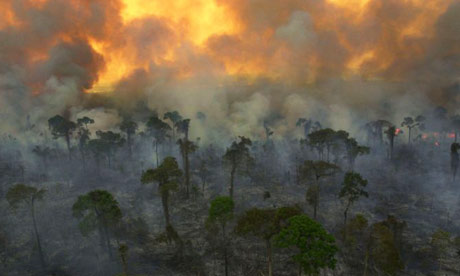
Tropical forests may dry out and become vulnerable to devastating wildfires as global warming accelerates over the coming decades, a senior scientist has warned.

Soaring greenhouse gas emissions, driven by a surge in coal use in countries such as China and India, are threatening temperature rises that will turn damp and humid forests into parched tinderboxes, said Dr Chris Field, co-chair of the UN's Nobel prize-winning Intergovernmental Panel on Climate Change (IPCC).

Higher temperatures could see wildfires raging through the tropics and a large scale melting of the Arctic tundra, releasing billions of tonnes of carbon into the atmosphere that will accelerate warming even further, he said.

Field, director of global ecology at the Carnegie Institute, told the American Association for the Advancement of Science meeting in Chicago at the weekend that the IPCC's last report on climate change in 2007 had substantially underestimated the severity of global warming over the rest of the century.

The report concluded that the Earth's temperature is likely to rise between 1.1C and 6.4C by 2100, depending on future global carbon emissions. "We now have data showing that from 2000 to 2007, greenhouse gas emissions increased far more rapidly than we expected, primarily because developing countries, like China and India, saw a huge upsurge in electric power generation, almost all of it based on coal," Field said. The next report, which Field will oversee, is due in 2014 and will now include future scenarios where global warming is far more serious than previous reports have suggested, he said.

(Continued here.)

Labels: , , ,

Monday, October 13, 2008

Building a Social Movement to Rescue a Nation and Heal the Earth

Address delivered by Jack Nelson-Pallmeyer
Westminster Town Hall Forum, Minneapolis, Sept. 25, 2008
(An audio of this speech is at Minnesota Public Radio.)

1. I want to thank the Westminster Town Hall Forum for the opportunity to address the topic: “Building a Social Movement to Rescue a Nation and Heal the Earth.”

2. Whatever criticism I receive today will likely NOT be that I shied away from big problems.

3. I want to highlight five critical challenges.
  • First, we have only a few years to address climate change and build a sustainable economy.
  • Second, in order to do so we must redefine security and fundamentally change U.S. foreign policies.
  • Third, the central focus of U.S. domestic and foreign policies must be to meet essential needs and enhance the quality of life while respecting the needs of future generations and the earth itself.
  • Fourth, to meet these challenges we must build a social movement with sufficient power to revitalize our democracy that at present is compromised by moneyed interests and corporate power.
  • Finally, because many people feel powerless, we must face these challenges with courage and hope.
4. One clarification: I chose a title which included “to rescue a nation” several months ago. I have been warning for years that the United States was headed for a fiscal train wreck. Evidence of a looming crisis abounded.
  • Wages were falling or stagnant;
  • Deceptive lending practices and sub-prime loans created trillions of dollars of paper profits, a housing bubble, and the illusion of expanded home-ownership. President Bush’s “ownership” society turned out to be a debt-peonage society built on Wall Street Ponzi schemes;
  • Millions of Americans survived or temporarily maintained living standards with credit card debt or by selling off their homes through home-equity loans;
  • Health care costs soared and the number of people with no or inadequate health-insurance rose steadily.
  • Basic infrastructure was allowed to deteriorate—from schools to the electric grid to roads and bridges. When a bridge collapsed we felt the tragedy but missed the larger significance;
  • War and war profiteering spiraled out of control. We had too long ignored General Eisenhower’s wise counsel that every gun or warship made was a theft from the poor and his warning of the “disastrous rise of…the military industrial complex.”
  • Trade and budget deficits, already massive, skyrocketed. Before the recent meltdown, the Bush Administration added $4 trillion to the national debt and the nation was running $850 billion annual trade deficits.
  • Trillions of dollars recycled from oil states and China passed into Wall Street where casino-like investment houses created (in the words of one astute observer—Harold Meyerson) “ever more dubious credit instruments, which yielded massive profits for Wall Streeters and their highflying investors” at the expense of the American people and the US economy.
  • Wealth disparities and income inequalities rose to levels not seen since the Gilded Age before the Great Depression. In 1980 the pay gap separating CEO’s from average workers was 42 to 1. In 2007 it was 344 to 1. In 2007 the top 50 private equity and hedge fund managers earned on average 19,000 times as much as the average worker.
In short, although I believed an economic train wreck was coming, I didn’t know the derailment would precede my talk. So when I speak today of rescuing the nation, my thoughts include but extend beyond the present economic crisis.

5. I come before you today with a commitment to honesty, a profound sense of urgency, and, a fragile but enduring sense of hope.

6. We are living in what I call the most important decade. We didn’t choose this but our past choices have led to this critical juncture. As Yogi Berra said: When you come to a fork in the road take it.

7. In a nutshell our dilemma, our great challenge, our responsibility is this: The decisions we make in the next few years will determine the quality of life for all future generations. This is the unwanted, unheeded message of the climate scientists.

8. Two years ago, James Hansen, lead environmental scientist at NASA, warned:
“We have at most ten years…[to make fundamental changes…] If human beings follow a business-as-usual course…life will survive, but it will do so on a transformed planet. For all foreseeable human generations, it will be a far more desolate world…”
8. Lester Brown, president of Earth Policy Institute and winner of the United Nations Environmental Prize, writes similarly:
"It is hard to find words to convey the gravity of our situation and the momentous nature of the decision we are about to make. How can we convey the urgency of this moment in history? Will tomorrow be too late?...Will someone one day erect a tombstone for our civilization? If so, what will it read? It cannot say we did not understand. We do understand. It cannot say we did not have the resources. We do have the resources. It can only say we were too slow to respond to the forces undermining our civilization. Time ran out…."
9. There is a huge and growing body of evidence that says we must act decisively NOW to avoid multiple climate-change-induced disasters. Threats include:
  • melting glaciers, rising sea levels, and coastal flooding that could trigger hundreds of millions of climate refugees;
  • hunger, famine and prolonged droughts with devastating crop losses;
  • expanding deserts;
  • disappearing coral reefs;
  • heat waves and destructive wild fires;
  • powerful hurricanes, flooding and bizarre rainfall patterns;
  • shortages of clean water;
  • spreading diseases;
  • resource wars; and,
  • extinction of 50% of species.
10. Critical thresholds have been crossed. The situation is urgent but not hopeless.
  • Hansen says, [A positive] outcome is still feasible…but just barely.”
  • The chair of the Intergovernmental Panel on Climate Change (Rajendra Pachauri), says, “If there’s no action by 2012, that’s too late. What we do in the next two to three years will determine our future. This is the defining moment.”
11. The enormity of the climate crisis forces an important question upon us: How do we live responsibly with what we know?

12. This question can only be answered with integrity if we have a deep desire to learn and a willingness to change our lives in light of our knowledge.

13. This may be what Jesus had in mind when he said “Blessed are those who hunger and thirst for righteousness, for they will be satisfied.”

14. Some news is hard to receive as blessing. I ride an emotional roller coaster as I try to come to terms with the implications of climate change.
  • I’m sad that our children’s future is threatened.
  • I’m motivated because of the love I feel for children, including my daughters—Hannah, Audrey and Naomi.
  • I resent the scientists who tell us the future is grim unless we change course now.
  • I am grateful that scientists alert us and call us to action.
  • I’m mad at myself and others for not acting sooner.
  • I’m inspired by growing citizen activism.
  • I begrudge living in the most important decade. Why me? Why now?
  • I’m glad to be alive at this critical moment. We have a chance to make a difference.
  • I feel trapped in a web of destructive systems that limit my choices.
  • I’m hopeful because I know that better public policies will make it easier for me and for others to act responsibly.
  • I am frustrated that my nation obstructs international efforts to address climate change and by the timid voices of many politicians.
  • I am encouraged by the growing chorus of voices demanding real change.
  • I feel overwhelmed.
  • I am determined because hope is often found amidst profound challenges that tempt us to despair.
15. Will Steger notes that in the United States “some people still don’t believe” [global warming] is happening” and that an “even greater danger is that some people think we can’t do anything about it.”
  • The public’s confusion isn’t accidental. Exxon Mobil, which set records for profits by a US corporation the past two years, distributed millions of dollars to dozens of groups to discredit the science behind global warming.
  • The Bush administration both distorted the science and silenced credible scientists.
16. The good news is that we can address climate change and build a sustainable economy in time to heal the earth. It won’t be easy but it’s possible.

Lester Brown by way of example lays out a practical agenda by which carbon emissions can be reduced by 80% and a sustainable economy built by 2020. Central features of his plan include:
  • Conservation.
  • Raising energy efficiency throughout the economy.
  • Phasing out coal and nuclear power plants.
  • Developing renewable energy resources.
  • Electric plug-in hybrid cars, high speed electric rail, urban mass transit systems—all powered by wind.
  • And Planting billions of trees to sequester carbon.
Brown also recognizes, as we must, that global warming is part of a broader crisis in which ecological needs clash with present economic practices and population growth trends.

This means developed countries must rapidly deploy renewable energy technologies and make them available to developing nations and also assist in efforts to end poverty, empower women, and restore broader ecological systems.

Our world is threatened by climate changes caused by burning fossil fuels. It is also fracturing and the earth’s ecosystems are faltering under the weight of present inequalities.
  • Nearly half the world’s people live on less than $2 a day.
  • The 3 richest people have assets greater than the combined gross domestic products of the 48 poorest countries.
  • Global population, currently at 6.8 billion will soar to over 9 billion by 2050 without a concerted effort to end poverty, restore the environment, and slow birth rates.
Brown lays out an “Eradicating Poverty Initiative” (similar to the UN’s millennium development goals). It would promote or provide:
  • Universal primary education and health care;
  • Adult literacy;
  • School lunch programs, and assistance to preschool children and pregnant women; and
  • Reproductive health and family planning.
He also describes “earth restoration goals” that include:
  • Reforesting the earth,
  • Revitalizing local and regional agricultural systems;
  • Protecting topsoil and biodiversity,
  • Restoring rangelands and ocean fisheries, and,
  • Stabilizing water tables.
Eradicating poverty and restoring ecological systems are inspiring goals that can unite diverse peoples and governments throughout the world.

I BELIEVE THESE GOALS SHOULD BE AT THE HEART OF A NEW AND CONSTRUCTIVE ROLE FOR OUR COUNTRY IN THE WORLD, a role many of us long for.

The price tag is modest, $161 billion a year.
  • This cost, which could be borne by many nations, is about a fourth of projected U.S. military spending in 2008.
  • It is less than two-thirds of the annual worldwide subsidies given to fossil fuel industries, [estimated to be $210 billion].
Although it is important that we stop being manipulated by a politics of fear, it is imperative that we fully grasp the urgent need to act to heal the earth. What is needed, according to Brown, is:
“[A] wholesale restructuring of the world energy economy with a wartime sense of urgency, much as the U.S. restructured its industrial economy in a matter of months at the beginning of World War II. The stakes in World War II were high, but they are far higher today. What is at issue now is whether we can mobilize fast enough to save our global civilization.” (p.67)
It is a hopeful sign that hundreds of cities and many states are moving forward to address climate change.
  • Minnesota adopted the best renewable energy standard in the country last year.
  • Many young people and communities of faith are organizing around this important issue.
  • Millions of Americans are changing light bulbs, driving less and walking, biking and using public transit more.
  • Even many reluctant politicians in Washington are now talking about global warming.
We must be careful, however, not to confuse their words--or the modest efforts taken so far by individuals, cities and states--with effective action.

17. Present responses to climate change are woefully inadequate. For example:
  • 80% reductions in carbon emissions by 2050 are too little too late;
  • The promise of “clean coal” is more illusion than reality.
  • Drilling more oil will reinforce our dependency not end it (As Thomas Friedman wrote recently—shouting “Drill, Drill” is the equivalent to yelling “Typewriter, typewriter.”
  • Nuclear power is an expensive, dangerous technology driven by corporate profiteers dressed green;
  • Corn-based ethanol is causing a myriad of problems as is Europe’s promotion of biofuel production based on Palm oil; and
  • Cap-and-trade systems that give permits to polluting corporations stifle rather than encourage technological innovation.
18. What many of these “non-solution” solutions or “partial solutions” have in common is they offer false hope that we can solve the climate crisis without us having to change.

19. They also tend to blind us to another fundamental problem: Serious efforts to address climate change and other pressing problems will inevitably be placed on back burners in a nation addicted to war.

WE MUST UNITE TO INSIST THAT THE BASIC NEEDS OF PEOPLE TODAY, THE ECOLOGICAL HEALTH OF THE EARTH, AND THE WELL-BEING OF FUTURE GENERATIONS ARE MORE IMPORTANT THAN PROFITS FOR THE MILITARY INDUSTRIAL COMPLEX AND UNREGULATED INVESTMENT HOUSES.

20. Those who say we can’t afford to address climate change, eradicate poverty, restore the earth’s ecological systems, or provide decent education and health care must explain:
  • Why it was so easy to launch and sustain a catastrophic and illegal war in Iraq that will end up costing a minimum of $2 trillion and to propose a trillion dollar bail out for irresponsible investment banks.
  • Why last year in a world threatened by catastrophic climate changes the United States spent 88 times more on war and war preparation than on addressing global warming.
  • Why last year the entire U.S. annual budget to help poor nations adapt to climate changes was less than 12 hours of Iraq War spending.
  • Why last year Congress approved $75 billion in R & D funds for new weapons systems and $3 billion for alternative energy.
  • Why last year Congress gave 58 cents of every dollar in the discretionary budget to war or national security and 4 cents to education, and 2 cents to the environment.
  • Why yesterday the U.S. House of Representatives approved the largest Pentagon budget in history;
  • Why in a world threatened by deepening poverty, despair and climate change the United States:
    • Accounts for half of all world military spending and more than half of global weapons sales;
    • Maintains more than 750 permanent military bases on foreign soil;
    • Positions itself to fight an endless series of wars for oil; and
    • Continues its disastrous occupation of Iraq, its ill-fated war in Afghanistan, and its fatally flawed and thoroughly counterproductive “wars against terrorism”.
21. The dilemma that lies at the heart of our challenge to rescue the nation is this: At the same time we must address an unprecedented climate crisis we are faced with an economic meltdown rooted in the distorted priorities of a militarized empire in serious decline.

22. Before someone walks out or turns off the radio because I used the word empire to describe the United States, let me clarify that I do so because the architects of our national tragedy these past eight years have used the word liberally, pridefully and arrogantly.
  • Ron Suskind, former Wall Street Journal reporter described a scene in 2002 in which a White House official, widely presumed to be Karl Rove, bristled at the suggestion that the Administration’s soon to be launched war with Iraq would be a disaster. According to Suskind, the official told him:
“that guys like me were 'in what we call the reality-based community,' which he defined as people who 'believe that solutions emerge from your judicious study of discernible reality.'….'That's not the way the world really works anymore,' he continued. 'We're an empire now, and when we act, we create our own reality.”
  • In 2003, just months after the invasion of Iraq, Dick and Lynne Cheney’s Christmas card included the following quote based on distorting a story in which Jesus describes a loving God who cares about sparrows and therefore cares much more for human beings:
“And if a sparrow cannot fall to the ground without His [God’s] Notice, is it probable that an Empire can rise without His aid.”
23. In my most recent book Saving Christianity from Empire I make what I think is a compelling case that:
  • The people who led and lied us into war with Iraq had plans to do so before the terrorist attacks of 9-11-2001;
  • They actively cultivated a politics of fear in the aftermath to build public support for their preplanned war; and,
  • The invasion of Iraq was linked to their much bigger agenda to unleash US military power to dominate the world.
24. I reached these conclusions after reading what the architects of the war with Iraq themselves had written. Two documents of special note:
  • The 1992 Defense Policy Review written by (Sec of Defense Cheney and his assistant Paul Wolfowitz) concluded:
1) The Soviet Union no longer existed and therefore there was no one to stop us;
2) U.S. foreign policy should be aimed at preventing the rise of any power or group of nations that would be capable of challenging the United States; and
3) To achievethis goal required aggressive, unilateral use of US military power.
  • The second document is the September 2000 report from the Project for the New American Century which laid out what Cheney, Wolfowitz and the other neocons called America’s Grand Strategy. Their goal was turn present military superiority into permanent global domination. They called for:
1) Dramatic increases in military spending.
2) Regime change in Iraq
3) Control of world oil supplies.
4) Significant expansion of U.S foreign military bases including permanent bases in the Middle East even though they understood this would fuel anti-American hatred and increase terror attacks.
5) Development a new generation of useable nukes.
6) Militarization of Space.
7) Deploying a missile defense shield.
8) Pulling out of international agreements that limited the unilateral use of US power.
9) Preventing formation or avoiding jurisdiction of the International Criminal Court.
Writing a year before the terror attacks they noted that they would have a hard time convincing the US people to adopt this agenda “absent some catastrophic and catalyzing event—like a new Pearl Harbor.”

25. Please, be furious at delusions of empire but don’t get mad at me for using the word.

26. The key point is that we have a realistic chance to rescue the nation and heal the earth. But, we can do so if and only if—I repeat—if and only if--we redefine security, reject empire, and help our nation become a good global partner.

27. Any realistic hope we have for a sustainable future depends on:
  • Ending the Iraq occupation and Afghanistan war immediately.
  • Reducing US military spending by 50% over the next few years;
  • Making deeper cuts as part of broader international efforts to redirect military spending to address global warming and other problems;
  • Converting war industries to production of wind mills, solar panels, electric rail systems, and other useful products; and
  • Focusing public investments on meeting the education, health care and housing needs of our people.
28. Given all the problems and contradictions I’ve highlighted I may not need to convince you of the need for different priorities and policies. I may need to convince you that there are good reasons to get out of bed in the morning, good reasons to be hopeful.

29. So I return to the wisdom of Yogi Berra: When you come to a fork in the road, take it.

30. Wouldn’t it be nice if the next time you were lost and you came to a fork in the road there was one obvious choice?
  • I believe that is the situation in which we find ourselves.
  • Many of us feel lost, disoriented, and sometimes nearly hopeless. That makes sense. After all, we know our nation is like a car traveling 150 mph on a road that leads directly over a cliff, call it “cliff road.”
  • We also know that most politicians don’t want to hurt their chances for election by talking about “cliff road” or asking too much from the public or by offending corporate donors who have made trillions of dollars building and maintaining “cliff road.”
  • The best they seem to offer is to slow the car down to 100 mph.
  • We know this solves nothing.
  • And so we look into the eyes of a loved one and think about the future and feel sad, a bit despairing, and a little cynical.
HOW ELSE ARE WE SUPPOSED TO FEEL?

30. I want to suggest that this is also a time to feel and be hopeful.
  • We have arrived at a fork in the road. One fork in essence means staying on “cliff road,” which is not a bridge to nowhere, but a road to predictable disasters.
  • The good news is that we and millions of others know that “cliff road” is not a viable option.
  • In my more than 30 years of public life I have never seen a time more ripe for building a social movement capable of moving our politics, our economy, and our nation in a hopeful direction.
  • In my campaign seeking the DFL Party’s endorsement for U.S. Senate I encountered thousands of people hungry for a politics of hope rooted in:
1) An honest assessment of our problems;
2) Belief in the possibility of real change and meaningful alternatives; and a
3) Call to mutual responsibility and action.
31. More good news: The roadmaps that for decades have guided us along “cliff road” are now thoroughly discredited. The discredited roadmaps include:
  • Militarization. There are no military solutions to most of the problems we face.
  • Unregulated greed. It can destroy a country and precipitate a global economic meltdown.
  • A politics of fear. Politics rooted in fear has led to unnecessary wars and systematic attacks on our decency and our democracy.
  • Arrogant unilateralism and claims of American exceptionalism. It is now clear to many citizens that the United States has not “been chosen by God” to “lead the cause of freedom” or “rid the world of evil”, as President Bush claims; and the world also rejects a version of these claims offered by democrats, typified by Madeline Albright’s defense of unilateral US military action: “If we have to use force it is because we are America. We are the indispensable nation.”
  • Finally, the idea that we can pursue our well-being at the expense of the earth and others is discredited.
32. WHAT AN OPPORTUNITY! THE TIME IS RIGHT TO CHOOSE ANOTHER PATHWAY!
  • Peaceful solutions NOT militarization.
  • Common Good NOT unregulated Greed.
  • An urgent politics of compassion NOT fear.
  • Global partnerships and humility NOT unilateralism and American exceptionalism.
  • Healing the Earth NOT impoverishing the earth and its people.
33. This urgent time can be a hopeful time if we face problems with honesty and courage. We need a movement building politics that empowers us to make vital social changes and to move candidates and elected officials to exercise the leadership we need.

We the people need to raise our voices and model alternatives in every appropriate setting—at home, at work, in our neighborhoods and faith communities, and within the body politic.

I hope that the ideas I have shared today, or something similar, will be widely discussed throughout this state as we forge solutions together.

Authentic hope requires honesty. The decisions we make in the next few years will determine the quality of life for generations to come. We cannot afford to live in denial.
  • Our country is unraveling.
  • Climate change does threaten.
  • We are headed rapidly towards a cliff.
  • Our democracy is in trouble.
But We cannot despair in the face of climate change or declining Empire.
  • We cannot be prisoners to small ideas.
  • We cannot live on false hope.
  • We cannot wait for miracles.
If it is true that hope depends on honesty it is also true that honesty depends on hope.
  • We will face problems and work to solve them when we are hopeful and have a vision for a better future.
  • We will make sacrifices when we believe our actions make a difference.
Strengthened by each other I believe we can sustain one another in hope. To live responsibly in the most important decade we must choose hope!
  • I’m not suggesting we look at the world through rose-colored glasses.
  • I’m not talking about clinging to dishonest or irrational hope.
  • I’m not promising rosy outcomes.
  • I’m not saying that technology will save us.
  • I’m not telling you don’t worry because God has a plan.
We need to be courageous if we are to build a sustainable society, challenge the military industrial complex and revitalize our democracy.
  • I’m asking us to embrace our responsibilities in the most important decade.
  • I’m asking us to free our imaginations, roll up our sleeves and keep working because the future is precarious but it isn’t fated.
  • I’m asking us to give expression to authentic hope through inspiring words and determined, daily actions.
When we choose authentic hope we accept our responsibility to act on behalf of present and future generations. I’m asking us to make sacrifices because we believe a better future is possible for our children and for our world. Let us live responsibly in light of what we know.
  • There are pathways forward.
  • We can address climate change.
  • We can build a renewable-energy economy.
  • We can help our nation transition from militarized empire to good global partner.
  • We can model sustainable lifestyles and build a sustainable economy.
  • We can demonstrate to ourselves and to the world that it is possible for a wasteful, resource dependent, materialistic culture to become a just and sustainable society.
  • We can help build a powerful social movement to revitalize our decaying democracy.
The first decade of the 21st century may well be remembered as the decade in which the United States denied the reality of global warming while pursuing the fantasies of empire.

It is up to each of us to insure that the second is known as the decade of global solutions because we the people believed in the possibility of change and found sufficient courage and hope to embrace the challenges of the most important decade.

Thank You.

Jack Nelson-Pallmeyer teaches in the Justice and Peace Studies Department at the University of St. Thomas and recently ran as a candidate for the U.S. Senate. The author of twelve books, he has spent his life addressing the issues of poverty, racism, and war.

Labels: , , ,

Tuesday, September 30, 2008

If you think Wall Street is bad, just wait till the methane hits the fan

In the past few days, researchers believe that the sub-sea layer of permafrost has melted away to allow methane to rise from underground deposits formed before the last ice age.

The Methane Time Bomb


Tuesday 23 September 2008
by: Steve Conner, The Independent UK

The first evidence that millions of tons of a greenhouse gas 20 times more potent than carbon dioxide is being released into the atmosphere from beneath the Arctic seabed has been discovered by scientists.

The Independent has been passed details of preliminary findings suggesting that massive deposits of sub-sea methane are bubbling to the surface as the Arctic region becomes warmer and its ice retreats.

Underground stores of methane are important because scientists believe their sudden release has in the past been responsible for rapid increases in global temperatures, dramatic changes to the climate, and even the mass extinction of species. Scientists aboard a research ship that has sailed the entire length of Russia's northern coast have discovered intense concentrations of methane - sometimes at up to 100 times background levels - over several areas covering thousands of square miles of the Siberian continental shelf.

In the past few days, the researchers have seen areas of sea foaming with gas bubbling up through "methane chimneys" rising from the sea floor. They believe that the sub-sea layer of permafrost, which has acted like a "lid" to prevent the gas from escaping, has melted away to allow methane to rise from underground deposits formed before the last ice age.

(Continued here.)

Labels: , , ,

Sunday, July 06, 2008

Rising temperatures mean we're headed for a 'weedy' world

Field of Canadian thistleBy Don Gordon

How plants will respond to global warming is of utmost interest. Which ones will survive? Which will perish? How will elevated temperature affect crop plants? Unfortunately the answers to those questions are far from definitive. Last week, Tom Christopher, writing in the New York Times, reported on a recent research project that is attempting to provide some answers on how the climate crisis might affect a group of plants we commonly call weeds.

What is a weed? Well, there are a myriad of definitions. One of my former professors said they were just a resource out of place. Emerson described a weed as “Any plant whose virtues have not been discovered.” Lowell said they were “no more than a flower in disguise.” No matter how they are defined, weeds have remarkable survival characteristics. For example, curly dock and mullein seeds will germinate after 70 years. Dandelions have managed not only to survive the best chemical arsenal known to man, but they have also been able to geometrically increase each year.

Some information on how plants will respond to global warming may be obtained by putting plants in a growth chamber and manipulating the temperature and carbon dioxide, but the results from a closet sized experiment may not be representative of what will happen in nature.

Lewis Ziska, a weed scientist with the U.S. Department of Agriculture, decided it was time to conduct research in the real world. He looked for three locations that might mimic not only present conditions, but also the mid-century future as predicted by the Intergovernmental Panel on Climate Change (IPCC) and something in between. He selected three sites. An organic farm in western Maryland was chosen to represent present conditions, a park on the edge of Baltimore for the intermediate site and one in downtown Baltimore for 2050 conditions. He took soil known to contain 35 common weeds from the organic site and established uniform plots in each of the rural, suburban and urban sites.

After five years, the plots were analyzed and the results even surprised the author. Weeds grew much larger in the urban areas where temperatures were hotter and carbon dioxide levels were elevated. In Baltimore, temperatures are three to four degrees hotter than the surrounding countryside. Carbon dioxide levels in the 440-450 parts per million in the urban areas were well above the national average. To put that in perspective the carbon dioxide level 50 years ago was 310 p.p.m.

Weeds loved this urban habitat. For example, the weed, Chenopodium alba, lamb’s quarters, was 6-8 feet tall on the organic farm, but a gigantic 10-12 feet in the urban area. In the urban area, succession was also greatly accelerated. In a normal situation annuals are the first invaders of bare sites, then perennials come in and are followed by trees and shrubs. The time period to woodland normally takes decades, but in the hotter carbon dioxide enriched area, trees covered the plots in just five years. This urban area looked as though it had been on steroids. For example, fast growing “weed” trees such as Ailanthus (tree of heaven), Norway maples and mulberries dominated the plots. The suburban park area with slightly lower temperatures and carbon dioxide levels followed the lead of the city environment, but it was a few years behind.

Ziska found that common weeds like Canadian thistle and quack grass are harder to control when carbon dioxide levels are increased. They not only grow faster, but are more resistant to herbicides. Fast growing weeds like ragweed may be bad news for allergy suffers. When carbon dioxide levels reach 600 parts per million (the level predicted at the end of this century) they produce twice as much pollen as plants did in 1957. It will also be bad news for individuals who come in contact with poison ivy because the plants will have more of the chemical that causes skin rash.

Are weeds growing faster now? Ziska believes there is good evidence that some are. For example, Cheat grass, Bromus tectorum, has been increasing since the Industrial Revolution. This plant has spread over 100 million acres in the West and it has destroyed many species of native grasses along the way. It is also very combustible, but it is able to survive fire while native species cannot. At carbon dioxide levels of 420 p.p.m, the growth rate of cheat grass increases significantly. That means the West can expect even more grassland fires in the future.

Another weed that is growing rapidly is kudzu, which is commonly known as "the weed that ate the South." This species has already spread to Illinois and by 2015 some researchers are predicting it may be as far north as the Upper Peninsula of Michigan. This vine would be a disaster in Minnesota.

Before man’s arrival there were probably no such things as a weed. Weeds appeared when agriculture began about 10,000 years ago. Any unwanted plant that showed up in an agricultural field was declared a weed. The more we attempted to eliminate these weeds the more resilient some became. Along the way, we bred the diversity out of our crop plants and made them more genetically uniform. The weeds that survive today are much better adapted to a changing climate than our crop plants because of their diverse gene pool. According to Ziska, “When you change a resource in the environment, you are going to, in effect, favor the weed over the crop. There is always going to a weed poised genetically to benefit from almost any change.”

The clear message here is that we are headed for a “weedy” world. That may not be all bad because these weeds may help solve the climate crisis. How, because they contain the genes for adaptability. Transferring genes from weeds to crop plants may be our way out of a bleak future.
_____
Don Gordon is professor emeritus of botany at Minnesota State University-Mankato.

Labels: , ,

Saturday, May 31, 2008

'An increased frequency and severity of heat waves is expected'

Under Pressure, White House Issues Climate Change Report

By ANDREW C. REVKIN, New York Times

The Bush administration, bowing to a court order, has released a fresh summary of federal and independent research pointing to large, and mainly harmful, impact of human-caused global warming in the United States.

The report, released Thursday, is online at climatescience.gov, along with a new report updating the administration’s priorities for climate research.

Most of the findings, like the spread of warmth-loving pests and the inevitable loss of low-lying lands to rising seas, are not new. But the report included new projections of how the poor, elderly and communities with lagging public-health and public-works systems will face outsize health risks from warming.

Among the report’s new conclusions on health: “An increased frequency and severity of heat waves is expected, leading to more illness and death, particularly among the young, elderly, frail and poor.” It added that deaths from cold would decline, but said uncertainties on both projections made it impossible to characterize the overall risk.

(Continued here.)

Labels: ,

Friday, May 23, 2008

Burning question: Does global warming exist, and if so, who created it? God or man?

Evangelicals launch campaign against global warming 'alarmism'
By Adelle M. Banks
Religion News Service

WASHINGTON - Evangelical leaders who reject arguments that climate change is human-induced but are nevertheless concerned about the environment are trying to gather 1 million signatures of people who agree with them.

The "We Get It!" campaign, launched May 15 at the National Press Club, includes a brief declaration that states "God created everything" and there is a God-given mandate to "tend his creation" and care for the poor.

"Our stewardship of creation must be based on biblical principles and factual evidence," the four-paragraph statement reads. "We face important environmental challenges, but must be cautious of claims that our planet is in peril from speculative dangers like man-made global warming."

The campaign is the latest in the back-and-forth battle between different strains of evangelicals. Some believe action is needed to protect the environment because human activity has caused its degradation, while others believe the notion of human cause is a fad and alarmist....

[P]articipants in the launch of the new campaign included Sen. James Inhofe, R-Okla.; Institute on Religion and Democracy President James Tonkowich; and Family Research Council President Tony Perkins.
More here. The credo of the movement is below:
The We Get It! Declaration

God Said It

God created everything. He made us in His own image, and commanded us to be fruitful and multiply and watch over His creation. Although separated from God by our sin, we are lovingly restored through Jesus Christ, and take responsibility for being good stewards.

We Get It

Our stewardship of creation must be based on Biblical principles and factual evidence. We face important environmental challenges, but must be cautious of claims that our planet is in peril from speculative dangers like man-made global warming.

They Need It

With billions suffering in poverty, environmental policies must not further oppress the world’s poor by denying them basic needs. Instead, we must help people fulfill their God-given potential as producers and stewards.

Let’s Do It

We will follow our Lord Jesus Christ and honor God as we use and share the principles of His Word to care for the poor and tend His creation.

Labels: , , ,

Thursday, May 15, 2008

$3.75 per gallon? That's cheap: Try $15 per gallon

From Plan B 3.0 by Lester Brown, the Earth Policy Institute:

One of the best examples of this massive market failure can be seen in the United States, where the gasoline pump price in mid-2007 was $3 per gallon [now $3.75 per gallon]. But this price reflects only the cost of discovering the oil, pumping it to the surface, refining it into gasoline, and delivering the gas to service stations. It overlooks the costs of climate change as well as the costs of tax subsidies to the oil industry (such as the oil depletion allowance), the burgeoning military costs of protecting access to oil in the politically unstable Middle East, and the health care costs for treating respiratory illnesses from breathing polluted air.

Based on a study by the International Center for Technology Assessment, these costs now total nearly $12 per gallon ($3.17 per liter) of gasoline burned in the United States. If these were added to the $3 cost of the gasoline itself, motorists would pay $15 a gallon for gas at the pump. In reality, burning gasoline is very costly, but the market tells us it is cheap, thus grossly distorting the structure of the economy. The challenge facing governments is to restructure tax systems by systematically incorporating indirect costs as a tax to make sure the price of products reflects their full costs to society and by offsetting this with a reduction in income taxes.

[Sources: International Center for Technology Assessment (ICTA), The Real Cost of Gasoline: An Analysis of the Hidden External Costs Consumers Pay to Fuel Their Automobiles (Washington, DC: 1998); ICTA, Gasoline Cost Externalities Associated with Global Climate Change: An Update to CTA’s Real Price of Gasoline Report (Washington, DC: September 2004); ICTA, Gasoline Cost Externalities: Security and Protection Services: An Update to CTA’s Real Price of Gasoline Report (Washington, DC: January 2005); Terry Tamminen, Lives Per Gallon: The True Cost of Our Oil Addiction (Washington, DC: Island Press, 2006), p. 60; adjusted to 2007 prices with Bureau of Economic Analysis, “Table 3–Price Indices for Gross Domestic Product and Gross Domestic Purchases,” GDP and Other Major Series, 1929–2007 (Washington, DC: August 2007); DOE, op. cit. note 16.]

Labels: , ,

Tuesday, May 13, 2008

World climate change 'without historical precedent'

by Tom Engelhardt
Tomgram

Already climate change -- in the form of a changing pattern of global rainfall -- seems to be affecting the planet in significant ways. Take the massive, almost decade-long drought in Australia's wheat-growing heartland, which has been a significant factor in sending flour prices, and so bread prices, soaring globally, leading to desperation and food riots across the planet.

A report from the Bureau of Meteorology in Australia makes clear that, despite recent heavy rains in the eastern Australian breadbasket, years of above normal rainfall would be needed "to remove the very long-term [water] deficits" in the region. The report then adds this ominous note: "The combination of record heat and widespread drought during the past five to 10 years over large parts of southern and eastern Australia is without historical precedent and is, at least partly, a result of climate change."

Think a bit about that phrase -- "without historical precedent." Except when it comes to technological invention, it hasn't been much part of our lives these last many centuries. Without historical precedent. Brace yourselves, it's about to become a commonplace in our vocabulary. The southeastern United States, for instance, was, for the last couple of years, locked in a drought -- which is finally easing -- "without historical precedent." In other words, there was nothing (repeat, nothing) in the historical record that provided a guide to what might happen next.

(The rest is here. This introduction leads into Bill McKibbon's article "The World at 350: A Last Chance for Civilization".)

Labels: , ,

World climate: 6 irreversible tipping points and other good news

The World at 350: A Last Chance for Civilization

By Bill McKibben
Sunday 11 May 2008

Even for Americans, constitutionally convinced that there will always be a second act, and a third, and a do-over after that, and, if necessary, a little public repentance and forgiveness and a Brand New Start — even for us, the world looks a little Terminal right now.

It's not just the economy. We've gone through swoons before. It's that gas at $4 a gallon means we're running out, at least of the cheap stuff that built our sprawling society. It's that when we try to turn corn into gas, it sends the price of a loaf of bread shooting upwards and starts food riots on three continents. It's that everything is so inextricably tied together. It's that, all of a sudden, those grim Club of Rome types who, way back in the 1970s, went on and on about the "limits to growth" suddenly seem... how best to put it, right.

All of a sudden it isn't morning in America, it's dusk on planet Earth.

There's a number — a new number — that makes this point most powerfully. It may now be the most important number on Earth: 350. As in parts per million (ppm) of carbon dioxide in the atmosphere.

A few weeks ago, our foremost climatologist, NASA's Jim Hansen, submitted a paper to Science magazine with several co-authors. The abstract attached to it argued — and I have never read stronger language in a scientific paper — "if humanity wishes to preserve a planet similar to that on which civilization developed and to which life on earth is adapted, paleoclimate evidence and ongoing climate change suggest that CO2 will need to be reduced from its current 385 ppm to at most 350 ppm." Hansen cites six irreversible tipping points — massive sea level rise and huge changes in rainfall patterns, among them — that we'll pass if we don't get back down to 350 soon; and the first of them, judging by last summer's insane melt of Arctic ice, may already be behind us.

(Scary? You bet. The rest is here.)

Labels: , , ,

Tuesday, April 01, 2008

James Hanson: Planet cannot afford any new coal plants

A letter to the Australian Prime Minister by James Hansen, Director of the NASA Goddard Institute for Space Studies:
27 March 2008
The Hon Kevin Rudd, MP
Prime Minister of Australia

Dear Prime Minister,

Your leadership is needed on a matter concerning coal-fired power plants and carbon dioxide emission rates in your country, a matter with ramifications for life on our planet, including all species. Prospects for today's children, and especially the world's poor, hinge upon our success in stabilizing climate.

For the sake of identification, I am a United States citizen, director of the NASA Goddard Institute for Space Studies and Adjunct Professor at the Columbia University Earth Institute. I am a member of our National Academy of Sciences, have testified before our Senate and House of Representatives on many occasions, have advised our Vice President and Cabinet members on climate change and its relation to energy requirements, and have received numerous awards including the World Wildlife Fund's Duke of Edinburgh Conservation Medal from Prince Philip.

I write, however, as a private citizen, a resident of Kintnersville, Pennsylvania, USA. I was assisted in composing this letter by colleagues, including Australians, Americans, and Europeans, who commented upon a draft letter. Because of the urgency of the matter, I have not collected signatures, but your advisors will verify the authenticity of the science discussion.
The rest is here.

Labels: , , ,

Saturday, March 29, 2008

BREAKING NEWS! Copernicus wrong! Earth still center of the universe!

Global warming not man-made, says presumptive Walz opponent

by Leigh Pomeroy

Even the most diehard climate change deniers are begrudgingly admitting that yes, global warming exists. Yet, they hurriedly add, man is not the cause: It's all a function of a natural cyclical phenomenon.

We expect this view from some neolithic politicians and the oil and coal company executives who feed them, but from a physician running for Congress? That's hard to believe, especially in light of the overwhelming evidence that (1) the rapid rise of greenhouse gases is causing global warming and that (2) this rise has been created by humankind's burning of fossil fuels.

But don't trust me on this issue. Ask the long list of climate scientists and distinguished researchers, including many Nobel prize winners, who say so.

So one has to wonder why a Mayo Clinic physician, certainly an impeccable credential not lightly gained, would proudly proclaim his adherence to the "mankind is not the cause" fringe group of climate change deniers. Okay, maybe he's just a contrarian. But no, that's not it. It's something much more sinister: He's a candidate for Congress.

The physician in question is Brian J. Davis, who just today was endorsed by Minnesota's 1st Congressional District Republican Party to face first-term Democrat Tim Walz.

Davis is not coy about his unorthodox (by a strictly scientific standard) stance. In a letter sent to area Republicans in January he wrote:
A large portion of this flawed Energy Act is based on the premise that global warming is influenced substantially by human combustion of fossil fuels which in the U.S. provide 86% of all our energy needs. While it is important to maintain high standards for air quality and to limit air pollution, there really is no consensus that global warming is man made. [Emphasis ours.]
Later on in the letter he added:
Our nation’s energy policy and economic well-being should not be based on the deeply flawed theory that carbon dioxide produced from fossil fuel combustion will lead to catastrophic climate change. [Emphasis ours.]
While the degree of "catastrophic" is still being debated among climate scientists, the consensus is clear: The levels of carbon dioxide in the earth's atmosphere are the highest they've been in 650,000 years — a time when the planet was much warmer than it is today. And those levels are slated to go even higher.

It is seemingly inconceivable that anyone with a serious scientific background in 2008 would question the overwhelming evidence that greenhouse gases as a byproduct of human civilization are at least a partial cause of global warming. Yet, surprisingly, there are a few still around, just as for well over a century there were those who denied the Copernican model of the heliocentric solar system.

If you want to find one, all you need to do is take a trip to the campus of the Mayo Clinic in Rochester, Minnesota, and ask for the guy who's running for Congress.

Labels: , , ,

Thursday, March 20, 2008

If the planet's climate were becoming more like hell, what would Jesus do?

Southern Baptists Back a Shift on Climate Change

By NEELA BANERJEE, New York Times

Signaling a significant departure from the Southern Baptist Convention’s official stance on global warming, 44 Southern Baptist leaders have decided to back a declaration calling for more action on climate change, saying its previous position on the issue was “too timid.”

The largest denomination in the United States after the Roman Catholic Church, the Southern Baptist Convention, with more than 16 million members, is politically and theologically conservative.

Yet its current president, the Rev. Frank Page, signed the initiative, “A Southern Baptist Declaration on the Environment and Climate Change.” Two past presidents of the convention, the Rev. Jack Graham and the Rev. James Merritt, also signed.

“We believe our current denominational engagement with these issues has often been too timid, failing to produce a unified moral voice,” the church leaders wrote in their new declaration.

(Continued here.)

Labels: , ,

Monday, March 17, 2008

If you think the roads are bad now, just wait a few years

Studies: Climate Change Threatens U.S. Roadways

by Kathleen Schalch All Things Considered, March 11

Scientists on Tuesday issued a warning of almost Biblical proportions to the nation's transportation planners.

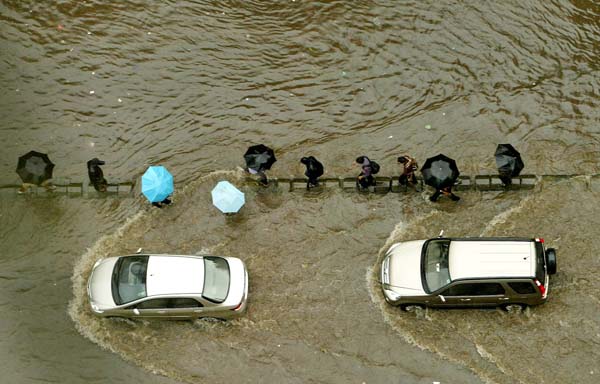
According to the National Research Council, much of the transportation system — including 60,000 miles of highways, major airports, railroads, low-lying tunnels and ports — will be increasingly vulnerable to flooding and sea-level rise.

(Continued here.)

Labels: , ,