SMRs and AMRs

Friday, March 23, 2012

Industrial pollution fouls Minnesota's rivers

Report says 1.5 million pounds of toxic chemicals dumped in Minnesota water each year

By Alicia Bayer, Mankato Green Culture Examiner

A report released today reveals that industrial facilities dumped 1,455,361 pounds of toxic chemicals into Minnesota waterways in 2010, including over 47,000 pounds into Mankato's Blue Earth River.

The report was released by Environment Minnesota and co-authored by the Frontier Group.

Wasting Our Waterways: Industrial Toxic Pollution and the Unfulfilled Promise of the Clean Water Act also reports that 226 million pounds of toxic chemicals were discharged into 1,400 waterways across the country.

The report found that  703,019 pounds of toxic chemicals were dumped by industrial facilities into the Mississippi River just in Minnesota.

(Continue reading here. The report is here.)

Labels: , ,

Friday, September 30, 2011

Michael Bloomberg cites citizen victory against coal in southern Minnesota

Beyond Coal Update: New Ulm, Minnesota Says No to Coal

Sep 28, 2011  |  Bloomberg Philanthropies

On Tuesday, the New Ulm Public Utilities Commission (NUPUC) in Minnesota voted "no" to a project that would have converted its steam plant to coal. New Ulm Citizens for Clean Energy has been working with the Sierra Club and the Minnesota Center for Environmental Advocacy (MCEA) to stop the project from moving forward since NUPUC applied for a permit from the Minnesota Pollution Control Agency in 2009.

Said Mike Bloomberg:

"This is great news for the people of Minnesota, and another important victory for the Beyond Coal Campaign. We are clearly witnessing the end of our dependency on coal and the move toward a cleaner energy future. As important we are helping to provide cleaner water and cleaner air to communities and our citizens across the nation."

(See more in the Mankato Free Press and New Ulm Journal.)

Labels: ,

Wednesday, July 06, 2011

For Minnesota GOP, extremism in defense of millionaires is no vice

Antitax Extremism in Minnesota

New York Times editorial

How far will Republican lawmakers go to protect millionaires? Those who think a default on the federal government’s credit seems implausible should take a sobering look at the “closed” signs dotting Minnesota. The Republican Party there readily shut down the state’s government on Friday by refusing to raise taxes on the 7,700 Minnesotans who make more than $1 million a year.

Gov. Mark Dayton, a Democrat, campaigned for office last year promising to raise taxes on high earners, so it was no surprise when he proposed a tax increase on families making more than $150,000 a year to help close a $5 billion budget gap. In negotiations with the Republican majority in the Legislature, he compromised and reduced the increase to those making $1 million or more, but Republicans are refusing to consider any income tax increase.

Like Republicans in Washington, they have the delusion that they can balance the budget entirely from cuts.

The governor proposed more than $2 billion in cuts but refused to slash billions more from education, health care and public safety programs. The Legislature also wanted new abortion restrictions and a voter ID law that Mr. Dayton had already vetoed. When he said no, lawmakers allowed the fiscal year to end without a budget, and state government officially shut on July 1.

More than 40 state agencies have closed, including the state parks over the July Fourth holiday. Courts and public safety agencies are operating, but essential services for the poor, like food pantries and child care subsidies, have evaporated. Many parents say they may have to quit their jobs if state-subsidized child care does not resume quickly. The shutdown will cost the state money, since many of the 22,000 laid-off workers will receive unemployment benefits and health insurance, while the treasury is unable to collect on tax audits, lottery tickets and park fees.

(Continued here.)

Labels: , ,

Wednesday, June 29, 2011

In the Wake of Fukushima: A Local Perspective (Part I)

Posted by Ross Pomeroy at Sun, 26 Jun 2011 17:57:32
RealClearScience.com

A Town Like any Other

Situated along the banks of the Mississippi River, Monticello is like most small towns in Minnesota. The citizens work in the growing local industries and businesses, or commute either north to St. Cloud or south to Minneapolis to work in larger metropolises. At the end of the day, they all come home to enjoy the life of a quiet, tight-knit river town.

The people of Monticello can enjoy one of the many beautiful local parks, use one of the state's finest free community centers, watch local high school athletics, and stay up-to-date on community happenings by reading the hometown newspaper - The Monticello Times. Citizens can even pick-up free potassium iodide pills at local drug and grocery stores. Each winter, they can also watch hundreds of handsome trumpeter swans nest near Mississippi Drive Park, where the Mississippi River is warmed from the hot water discharged by the Monticello Nuclear Generating Plant.

The 613 megawatt nuclear power plant, located about forty miles from the Twin Cities metropolitan area, casts a large shadow over the almost 13,000 residents of Monticello, and touches the lives of an additional three million people who live within a fifty mile radius. After the Fukushima-Daiichi disaster, the shadow cast by the facility has grown even bigger. Before the incident in Japan, most citizens in Monticello went about their day-to-day activities with little thought given to the closed-off nuclear facility just the north of town. But after the calamity, you can bet that most families gave their evacuation plans (in case of a nuclear accident at the plant) a thorough refresher.

(Continued here, followed by Part II and Part III.)

Labels: ,

Sunday, March 13, 2011

Minnesota GOP legislators plan to ease coal restrictions

"Several young people testified to the House and Senate committees, saying they are concerned about the problems coal will cause to the world they inherit." — Capitol Chatter
By PATRICK CONDON
Associated Press

ST. PAUL, Minn. (AP) — Minnesota legislators moved Tuesday to lift state restrictions on carbon dioxide emissions from coal production that critics said has amounted to a moratorium on the construction of new coal plants.

Republican-controlled House and Senate committees passed matching bills to lift a state law passed just four years ago. The coal plant provision was one piece of a larger series of reforms meant to boost renewable energy production and clean up Minnesota's environment, which passed with wide bipartisan support and was signed by Republican Gov. Tim Pawlenty.

Under the current law, utilities can only build and operate new coal plants in Minnesota only if they can offset carbon emissions to a level that they don't add to the amount of carbon in the atmosphere. Critics said the options for achieving that offset are so expensive and burdensome they amount to an effective moratorium on new plants.

(More here.  See also the article from the Capitol Chatter.)

Labels: ,

Monday, August 02, 2010

Words of Wisdom from Gov. Timmy

Mr. Pawlenty’s trip this weekend was his fifth to Iowa in less than a year, one of many signs that he is working the state as intently as any prospective Republican presidential hopeful.

Gov. Tim Pawlenty of Minnesota concluded a three-day visit to Iowa on Monday, his latest trip to the state that traditionally opens the presidential nominating contest. The Republican was campaigning for local party candidates, but said he planned to decide by early next year whether to run for president in 2012.

The Times’s Jeff Zeleny rode along with Mr. Pawlenty as he traveled from Waverly to Cedar Rapids, and interviewed the governor on the coming midterm elections, partisanship in Washington and more. Here are 10 questions from the interview, with some of the answers condensed.

Q. What is your take on the country’s mood and what are voters looking for?

A. “They’re frustrated and worried about whether they’re going to have jobs. And they’re really worried about government overreach and government spending. There are a lot of folks who are independents or Democrats – maybe conservative Democrats – who voted for President Obama and thought he might be more pragmatic or centrist than he’s turned out to be. They feel that he’s conducted a bait-and-switch operation on them, and now they’re going to fix it by voting Republican come November.”

(Continued....)

VV NOTE: As residents of Minnesota we have become dismayed with both Mr. Pawlenty's lack of constructive leadership at the helm of state and his oh-so-thinly-disguised run for the 2012 GOP presidential nomination. Mr. Pawlenty is both charming and intelligent, two very positive traits in a politician when he has the best interests of the people in mind. But Mr. Pawlenty, despite a history of being a moderate Republican in the Minnesota House, has veered sharply into the "cut government and cut taxes" school of politics.

Despite his repeating and practicing this mantra ad nauseam, and through his refusal to find common ground with the Minnesota legislature, he has merely succeeded in shifting the tax burden from the state (income and sales taxes) to the county and local governments and school districts (property taxes). The result is county and local governments struggling to keep up with state mandates but without state funding, and many school districts, once the model for the nation, just trying to tread water.

Two examples of the Pawlenty legacy: Whereas once one had to cross the borders of Iowa and South Dakota to Minnesota to find good roads, now it's just the opposite. And perhaps even more telling of what a Pawlenty presidency might yield, the wealthiest Minnesotans actually pay a lower percentage of tax on their earnings than middle class Minnesotans.

The ultimate danger of Tim Pawlenty is not that he is just another George W. Bush, but that he is another George W. Bush with brains.

Labels: , ,

Tuesday, July 20, 2010

Target Corp. funds ad for Minnesota GOP gubernatorial candidate

The corporate money is beginning to roll in:
Ad supporting Tom Emmer funded by Target, Polaris, Hubbard Broadcasting, Davisco

by Tom Scheck, Minnesota Public Radio
July 20, 2010

St. Paul, Minn. — A group funded by Minnesota corporations has begun running a TV ad praising Republican gubernatorial hopeful Tom Emmer. The ad is the latest effort by an independent group that hopes to influence elections.

The ad focuses on Emmer's commitment to Minnesota businesses.

"As a legislator, Emmer voted against job-killing taxes and for reduced government spending. Now he's running for governor, working to grow jobs, getting government out of the way," the ad stated in part.

The ad looks like one Emmer's campaign would run -- but it's not. In fact, Emmer isn't even allowed to communicate with the group that paid for the ad, called Minnesota Forward.

Minnesota Forward is an umbrella organization that's funded by Minnesota businesses including Target, Polaris, Hubbard Broadcasting and Davisco Foods. Because of a U.S Supreme Court ruling earlier this year, those businesses and other companies are now allowed to spend corporate money to influence elections.
More here. Thanks to Project Vote Smart, there is an abundance of information on Tom Emmer's votes in the Minnesota House. And here are his interest group ratings. And his issue positions.

Labels: , , ,

Monday, March 01, 2010

Minnesota appliance rebate incompetency excuse from the 'blame it on someone else' department

"Malicious Attack" May be Behind Slow Rebate Response
(Vox Verax note: Yeah, ri-i-i-ight.... Continued below.)
KSTP News, Twin Cities

UPDATED BELOW

Many viewers have emailed or called 5 EYEWITNESS NEWS Monday morning, saying they are having trouble getting through to the Minnesota State Department of Commerce, trying to sign up for new appliance rebates.

March 1st is the first day people can sign up for hundreds of dollars in rebates on appliances like dishwashers, refrigerators, and washers.

Nicole Garrison-Sprenger, spokeswoman for the Minnesota Department of Commerce says while the number of callers is an issue, she believes a "malicious cyber attack" may be the main reason why people are having trouble getting through. The Commerce Department currently has 10 IT people trying to fix the problem.

Garrison-Sprenger says a third-party vendor is handling the phone lines and website for Minnesota's appliance rebate program, along with other states, like Michigan. She says someone may have hacked into the system, causing major slowdowns.

(Original here. Our opinion: We don't think so. The Minnesota Department of Commerce had plenty of time to predict and be prepared for the possibility of a cyber attack. This is state government incompetence pure and simple. See "Minnesota appliance rebate application system overwhelmed ... as predicted" below. NOTE: At 4:30 pm Monday I was able to get into the online form and secure the rebate reservation.)

Labels: , , ,

Minnesota appliance rebate application system overwhelmed ... as predicted

Tim Pawlentyby Leigh Pomeroy

UPDATED BELOW

A month and a half ago I predicted to my state legislators that the application process for the Minnesota Trade-in and Save Appliance Program would be a mess. Well, that prediction is playing out right now as I wait for the online application servers to stop crashing and for the phone lines to stop telling me that all circuits are busy, please call back later.

This is hardly surprising. When you're running state government with the express purpose of destroying it, as Mr. Pawlenty is, what else would you expect?

Energy Star is a good thing. Rising political star is another matter....

FLASH UPDATE!

Our friend, brilliant raconteur, antique farmhouse and furniture restorer, Asian culture and history specialist, sculptor, screenwriter and confirmed German bachelor Thomas P. Hagen has just learned from the Minnesota governor's office that Mr. Pawlenty's last act before exiting his position will be to declare a new name for the former state of Minnesota ...

Minnessippi

(No offense to the people of that lovely southern state located just west of Alabama.... NOTE: At 4:30 pm Monday I was able to get into the online form and secure the rebate reservation.)

Labels: , , ,

Saturday, December 13, 2008

Progressive Ponderings: Community Organizers

by Joe Mayer

Last Saturday, Dec. 6, we spent a delightful evening with over 800 progressive "community organizers." The occasion was the annual Awards Dinner of TakeAction Minnesota. Receiving recognition was the Transit Partners Coalition – the organization that led a successful bipartisan effort to pass a transportation bill – and the progressive movement in Rochester, Minn. The theme this year was "This Is Our Time."

TakeAction is a coalition of thirty-two progressive organizations including unions, cultural associations, rural groups, homeless advocates and urban organizations. Printed in the program was its goal: "The mission of TakeAction Minnesota is to unite and expand the power of diverse individuals, organizations and communities in active grassroots democracy that builds social, racial and economic justice. We work collectively with our members and allies to make lasting change by building the power to govern…."

One story of hope is about how Rochester brought about change in just four to six years, a story about what can happen when citizens take responsibility for their own governance.

First District Congressman Tim Walz introduced the Rochester award recipients. His words: "Just four years ago Rochester was considered a Republican stronghold. The area had not sent a Democrat to the State House or Senate in 30 years. This year progressives (three state representatives and Rep. Walz himself) were re-elected in races that weren't even close (each won with over 60% of the vote). What happened? Activists and organizers in Rochester have led and won community campaigns for years, shifting the balance of power in the city…."

Walz went on to name numerous organizations and individuals responsible. He concluded: "Tonight, that movement will be represented by segments of the movement… AFSCME and SE MN Area Labor Council, Livable Rochester, The New Faces of America (a Somali group), SE MN Alliance of Peacemakers, and the Earth Community Coalition of Olmsted."

Being an activist and working within some of these organizations, it is often difficult to recognize the sea-change surrounding us. The gruesome pronouncements and news emanating from Washington and the Bush administration caused us to think that, at best, we were treading water.

But the 2006 elections brought hope. Then 2008 exploded with millions of new voters and thousands of new activists becoming involved. This is democracy at work! As one Saturday speaker noted, "We are the ones we have been waiting for." Another stated, "This change didn't happen to us. It changed because of us."

The progressives we elected need us more than ever as they begin governance. Conservative money will thwart them on every issue. The "right" ridiculed Obama, the "community organizer." We all need to become C-O-M-M-U-N-I-T-Y O-R-G-A-N-I-Z-E-R-S.

Labels: ,

Friday, May 23, 2008

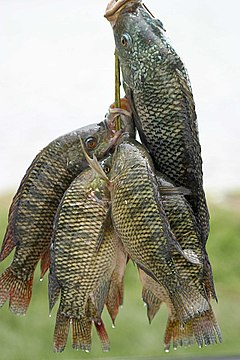
Tropical tilapia grown in Minnesota

No-Guilt Fish

Fish seems to come in two varieties these days: nearly extinct and terrifyingly toxic. Is there any hope for a good-hearted fish-and-seafood lover? Actually, lots.


BY DARA MOSKOWITZ GRUMDAHL, Minnesota Monthly

Do you know where all the live tilapia for the Hong Kong expat community in Vancouver comes from? Renville, Minnesota—a little town off Highway 212 about halfway between Shakopee and South Dakota, in sugar-beet country. And pretty much all the live tilapia in Toronto and Calgary comes out of Renville, too—hundreds of thousands of pounds of fish. “We ship them in water that stays warm all the way to Vancouver, though there’s only a certain amount of time before the quality of the water changes for fish respiration,” Mel Stocks, one of the founders of MinAqua, the outfit that raises the tilapia, told me. “So we send two drivers.”

MinAqua is actually a co-operative. It’s owned by more than 300 farmers, mostly sugar-beet farmers, who were looking for a way to use the excess heat generated by their beet-processing plant. They figured out they could use that heat as a way to warm ponds, and the rest of it was easy: Tilapia are vegetarians, so the Renville farmers could raise the feed themselves, and the waste the fish generate is a lot cleaner than, say, hog waste, so they use it to fertilize their fields. That’s how a bunch of Minnesota sugar-beet farmers became major tilapia producers—super-green ones at that.

(Continued here.)

Labels: , ,

Tuesday, March 11, 2008

Anti-tax politicians need to get perspective

You can't support wasteful wars at the expense of home improvements

by Leigh Pomeroy

Those folks who decry taxes, like Minnesota Gov. Tim Pawlenty, need to get a grip on perspective. Pawlenty, for example, decries a five-cent per gallon gas tax increase in his state, but he never says a word about the cost of the Iraq war to Minnesota's citizens, a war fully supported by his president (George Bush) and his favorite presidential candidate (John McCain).

So let's put this in perspective.

Latest figures indicate that the war in Iraq has reached a $12 billion a month burn rate ("Studies: Iraq war will cost $12 billion a month"). That means the war is costing each Minnesotan about $39.50 a month or $474 a year, not including lives lost, families disrupted, communities impacted and other long-term effects.

A five-cent per gallon gas tax increase will cost Minnesota drivers about $2.35 a month or $28 a year, about six percent of the cost to each Minnesotan for the Iraq war.

According to the National Priorities Project, the war in Iraq has cost Minnesotans over $12 billion to date, or about $2,300 per person. $12 billion would replace a lot of highway taxes. Let's see, at a cost of $32 million per penny of gas tax per year (according to 2005 figures), what Minnesotans have incurred for the war would have paid for 15 years of gas taxes even at the new rate (as of the end of 2008) of 25 cents per gallon.

So when politicians start yelling and screaming, "No new taxes! No new taxes!" look beyond the rhetoric to where the real money is being spent. Like the old adage says, it doesn't pay to be penny wise while pound foolish.

Labels: , , ,

Wednesday, March 05, 2008

Mayo Clinic to Canadian Pacific Railroad: Safety first

Mayo submits safety proposals for railroad

By Jeffrey Pieters, Post-Bulletin, Rochester MN

Flammable and hazardous materials, such as ethanol, propane and anhydrous ammonia, carried through Rochester on the Dakota, Minnesota & Eastern Railroad, pose a bigger public safety threat than coal ever did.

So says Mayo Clinic in a written statement to federal regulators reviewing Canadian Pacific Railway's proposed acquisition of the DM&E.

The statement was to be filed today with the federal Surface Transportation Board, which will decide by fall whether to allow the acquisition, and under what conditions to allow it.

What Mayo wants

Mayo Clinic's proposed safety requirements for the railroad line through Rochester include requiring the railroad company to:
  • Build multiple grade-separated road crossings of the tracks, meaning using bridges or tunnels.
  • Adhere to local speed limits of 10 mph for trains carrying hazardous cargo and 20 mph for other cargo.
  • Inform Rochester emergency services before hazardous materials are sent through the city.
  • Limit the number of trains through Rochester.
(The rest is here.)

Labels: , ,

Wednesday, February 27, 2008

In Minnesota, a half-dozen Republican heroes

Leigh Pomeroy

Reasonable folks in the Grand Old Party are hard to find these days. But there are some — at least six members of the state house in Minnesota, in fact, where the governor seems more interested in running for vice president of the United States than in performing his current duties.

These six Republicans did the unthinkable: They voted against their party's dictates to override the governor's veto of a very reasonable and long overdue bill to begin refunding the state's deteriorating transportation systems.

Remember, this is the state once heralded for its great infrastructure that just last year witnessed one its major highway bridges disintegrate into the Mississippi River. And it wasn't even the river's fault.

So what did these six Republicans get for voting their consciences instead of their party dictates?

To begin with, stripped of their committee leadership positions. And in the future who knows what else? The threat of losing their party's endorsement for re-election. Ostracism. Shunning. Even perhaps being labeled with the scarlet "A" — Anti-party bosses.

Now if the Democratic (DFL) leadership in Minnesota pulled such a stunt, they would hear about it. After all, this is a long-time DFL state that has from time to time elected moderate Republicans thanks to wide support among moderate DFL voters. Two recent examples are Gov. Arne Carlson and Sen. Dave Durenberger.

In fact Gov. Tim Pawlenty's two victories can be attributed to moderates — both independent and Democrat — voting for strong, moderate third party candidates. In 2002 it was former Rep. Tim Penny, and in 2006 it was former Minneapolis School Board Superintendent Peter Hutchinson.

Of course, like the president who campaigned on being a "compassionate conservative" in 2000, Pawlenty turned out to be quite different than the product that was advertised. Instead of showing reasonable leadership, he became a pawn of the anti-tax faction of the Minnesota Republican Party.

But back to our six Republican heroes. Just for the record they are:
  • Rep. Jim Abeler, Anoka
  • Rep. Rod Hamilton, Mountain Lake
  • Rep. Kathy Tingelstad, Andover
  • Rep. Bud Heidgerken, Freeport
  • Rep. Ron Erhardt, Edina
  • Rep. Neil Peterson, Bloomington
Many years ago, a guy named John F. Kennedy wrote a book entitled Profiles in Courage revealing the stories of a number of American statesmen, politicians and citizens who went against the grain to do what was right. If there were a Profiles in Courage for Minnesota in the early part of the 21st century, these six would more than qualify.

For more on this story see:

Labels: , ,

Sunday, February 24, 2008

Minnesota's version of a "bridge to nowhere"

Highway bridges in Minnesota have been in the news lately, but this is a story about one few folks have ever heard of....

Alaska isn't the only state to propose "bridges to nowhere." Such earmarks happen all the time, albeit on a less grandiose scale. One such proposal, valued at only $1.6 million instead of $238 million, is unfolding in Minnesota's rural Blue Earth County, recognized as having more rivers and streams than any other county in the state.

Rivers and streams are all very nice for the scenery, but they also mean there is a need for more bridges if the populace is going to get around. The County has recently secured $800,000 in federal funding to pay for half the cost of replacing the 107-year-old historic one-lane bridge over the scenic Blue Earth River and widening the road.

But many residents of the nearby Amboy, population 528, aren't so sure. Amboy is mostly known as a farming center, yet it is also the home of the tiny Amboy Cottage Café, which serves locally grown foods to area residents and others willing to drive the distance for its exceptional meals.

Lisa Durkee, the owner-operator of the café, and a number of other local residents are dead-set against the new bridge, which they argue is unnecessary because another bridge over the river is less than a mile and a half away. Instead, they propose abandoning (at least to vehicular traffic) the current one-lane bridge, which everyone agrees is substandard, and turning the area into a county park. This, they argue, will better benefit their town.

Except for one article in the Mankato Free Press in September of last year, the local media has to date ignored the controversy. But the story was picked up by the Star Tribune earlier this month. Here's what reporter Jim Foti writes:
The Dodd Ford Bridge is about as quiet as a country bridge can be, but spend a little time there and you'll understand what all the ruckus is about.

There are the farmers who hope to see a new concrete bridge that can handle their truckloads of hogs and corn.

There are the Blue Earth County leaders, federal money in hand, who plan to replace the rickety bridge and straighten a curve in the road.

And there are the people who love the ambience and rustic setting of the 107-year-old wood-decked bridge, who see it as an amenity to be saved, not a threat to drivers.

While everyone agrees that the bridge needs attention, not everyone agrees on spending $1.6 million to replace a bridge that carries only about 35 cars a day.

The conflict highlights the kinds of choices that are made in a state with more than 1,000 structurally deficient local bridges and tight transportation budgets.
The rest of Foti's story is here. No doubt with the state's legislature and governor fighting over transportation funding even little stories like this — and the Amboy residents' battle with the county over this "bridge to nowhere" — will soon become better known.

Labels: ,

Monday, July 16, 2007

Minnesota elections: Big changes can come from small places

Long-held GOP seat in Minnesota Legislature could be taken by Democratic newcomer

by Leigh Pomeroy

At one time Rep. Steve Sviggum was riding high, ruling the roost in the Minnesota legislature. He was the almighty Speaker of the House when the Republicans were in control from 1999 to 2007. And he ruled with an iron fist — and sometimes a hot-headed temper — more often than not often prevailing over Gov. Jesse Ventura and the Senate during Ventura's term of office, and acting as Gov. Tim Pawlenty's "go to" guy on Republican issues from 2003 to 2007.

But the election of 2006 brought a big change, with Democrats (called DFLers in the North Star state) taking both houses of the legislature for the first time in eight years.

Though retaining his seat, Sviggum lost his powerful position as Speaker, and at least some in his party began to doubt his effectiveness as a leader. He had campaigned actively for GOP candidates in the fall of 2006, and nearly all had gone down in flames. Perhaps to add insult to injury, the House Republicans didn't even retain him as their minority leader.

Thus, it's not surprising that Sviggum, having lost his clout and perhaps honor, accepted the position of Commissioner of Labor and Industry starting in July, thus vacating his House seat in rural southeastern Minnesota, which he has held for 28 years.

With this record, observers might be tempted to automatically hand the seat over to Steve Drazkowski, the recently endorsed Republican candidate for the special election to be held August 7. But there are a number of reasons why this assumption might not hold.

First, except for his occasional temper tantrums, Sviggum is very personable and well liked by his constituents and even those who more often than not disagree with him on political issues. Virtually everyone in his former district either knows him or is related to him, or so it seems.

Drazkowski, on the other hand, is not that well known. In 2006, he ran and lost against Democrat Steve Murphy for the Minnesota Senate seat that includes Sviggum's District 28b and District 28a, which is currently held by Democrat Sandy Wollschlager. Drazkowski's website point outs, however, that he "outpolled 14-year DFL incumbent Steve Murphy in House District 28B." Yet the count was only 143 votes (7,997 to 7,854), according to Minnesota Monitor, or less than one percent of the vote.

Drazkowski carries at least two other bits of baggage with him into the race. The first is an arrest, but no conviction, on domestic assault charges. Politics in Minnesota writes:
Drazkowski's easy endorsement is somewhat of a surprise. Several years ago, "The X," as some GOPers call him, was charged with fifth degree domestic assault for allegedly hitting his teenaged daughter. He was acquitted, and the records are sealed. His daughter has been with him on the campaign trail and his nomination was seconded by her. Local gossip has also focused on Drazkowski's protracted divorce, which lasted from 1993-2007. [No typos here. And, a round of applause to anyone who survives a 14-year divorce proceeding.]
The second is his election campaign complaint against two fellow Republicans for smearing him at an endorsing convention in 2006 over this issue. The complaint was dismissed, but state GOP chair Ron Carey called on Drazkowski to end his campaign, according to the Winona Daily News.

DFL candidate Linda Pfeilsticker, on the other hand, is a relative unknown, having upset 2006 Sviggum opponent Jeff Flaten at the party endorsing convention July 10. Yet according to A Bluestem Prairie, she is an enormously popular teacher, and enormously popular teachers have done very well in southern Minnesota if Tim Walz's surprise upset in the 2006 congressional race is any indication. Other teacher-legislators in southern Minnesota include Gene Pelowski (Winona), Andy Welti (Plainview), Robin Brown (Albert Lea), Jeanne Poppe (Austin), Kathy Sheran (Mankato) and Terry Morrow (St. Peter).

Another trend that should favor Pfeilsticker is that the surrounding legislative districts have recently been slipping from GOP to DFL control. These include:
  • District 26b - Patti Fritz upset Lynda Boudreau in 2004 and retained the seat in 2006.
  • District 27b - Jeanne Poppe took the seat from Jeff Anderson in 2004 and retained it in 2006.
  • District 28a - Sandy Wollschlager won the seat in 2006, replacing Republican Jerry Dempsey, who retired.
  • District 29b - Kim Norton won in 2006, replacing Fran Bradley, who did not run.
  • District 30a - Tina Liebling defeated Carla Nelson in 2004 and held her seat in 2006.
  • District 30b - Andy Welti upset Bill Kuisle in 2004 and was reelected in 2006.
  • District 31b - Ken Tschumper took the seat from 16-year veteran Greg Davids in 2006.
Minnesota's struggling Republican Party will be looking to reverse its recent losses. On top of losing the state House in 2006, it retained the governorship only because of a strong 3rd party challenge by Peter Hutchinson and a lackluster campaign by DFL candidate Mike Hatch. Thus, the seemingly innocuous 28b race portends more than just a local election. It could very well be a canary in the coalmine for the Minnesota GOP, and, because of the nation's dissatisfaction with the president, perhaps even the country as well.

Labels: , , , ,

Friday, April 13, 2007

What's Wrong with a Sales Tax on Clothing?

by Leigh Pomeroy

Minnesotans are stubborn lot. They don't take to change well. That's why if you were to suggest that one option for recovering some of the state's lost revenue over the past six years is to charge sales tax on clothing, you'd probably get just one reaction:

"Horrors!"

Tax increases of any type don't sit well with most folks. And they're correct to be skeptical. But the ones who often yell loudest about tax increases are those who have benefited most from taxes paid by citizens in the past.

If you're a businessman and you rely on an intelligent workforce, you can thank public schools; if you rely on trucks to get supplies to your factory and products to market, you can be thankful for public roads; if you take for granted a stable economic system, you can thank state and federal regulatory laws; if you can assume your factory is not going to be broken into and everything stolen, you can thank the public police force.

In short, so much of what we take for granted today was paid for by generations prior to ours in the form of taxes. What right does anyone have to say that this generation of taxpayers should not do the same for the next?

One tax that has proven to be effective in 45 of our 50 states is the sales tax. It works on a very simple premise: The more you buy, the more you pay. Yes, it can be regressive and a burden on those at the lower end of the economic scale. That's why sales taxes have to be employed with caution. And that's one reason why in Minnesota there are no sales taxes on certain "basic necessities," including home heating fuels, prescription drugs, some medical devices, food and clothing.

But clothing? How many of the clothes we buy today are "basic necessities"?

Exempting clothing from sales tax at one time made sense when most Minnesotans had to scrape to come up with enough money for a winter coat. It also made sense when virtually all clothing worn by Americans was made from American cotton, wool and leather, and stitched together by American workers.

But today most clothing comes from overseas. And while it's very nice of us to support clothing manufacturers in Central America, China, southeast Asia, India and eastern Europe, should we do so by giving those imported goods such a significant tax break? I don't think so.

Minnesota in the minority

As far as sales tax on clothing goes, Minnesota is in the minority. According to Minnesota House Research, only 10 states do not charge sales tax on clothing, and of those half do not charge any sales tax at all. The only states that charge sales tax but exempt clothing are, besides Minnesota, Massachusetts, New Jersey, Pennsylvania and Rhode Island, all of which had thriving clothing manufacturing industries prior to globalization.

And yet in Minnesota sales tax on clothing isn't even on the discussion table.

Gov. Pawlenty, of course, opposes any kind of tax increase anywhere. He seems to think that the state, counties, cities, townships and school districts all run on air. And he's got supporters in the legislature.

One particularly humorous recent example is when Rep. Tony Cornish, R-Good Thunder, a notorious taxophobe, wanted the state to pony up earmarked funds to help schools in his district. Some folks are good at taking, but giving? Oh no, not me.

Still, apart from what the governor thinks, there isn't even a whiff of a bill pending in the DFL-controlled state legislature about applying sales tax to clothing. Similarly, at Minnesota Public Radio's Budget Balancer, over 70 percent of the survey's respondents say sales taxes should remain unchanged, implying strongly that they're not crazy about tax on clothing either.

At one time clothing was considered like food and housing to be a necessity. And yes, it's still a necessity unless we all want to run around naked. Even with global warming, Minnesota is still projected to be cold during the winter.

But let's face it, for most Minnesotans clothing is more about style than it is about staying warm. And to me, style is a luxury, something that's optional. That's why applying the sales tax to clothing makes a whole lot of sense.

So just imagine what we could do with a sales tax on clothing: We could help a whole lot of Minnesotans who need health care, for instance, thanks to other Minnesotans paying an extra $5 on a new pair of $80 designer jeans.

Labels: ,

Sunday, April 01, 2007

Governor 'Veto' and His Amazing Superpower

"House approves gas tax increase despite Pawlenty veto threat"

"Tim Pawlenty has threatened to veto any income tax increase"

"...a license tab fee increase and a metro sales tax for transit will face his veto pen, Pawlenty said"

"Minnesota Gov. Threatens Veto Over Gay Partner Benefits"

"Pawlenty has threatened to veto any bill that raises state taxes"

"Pawlenty is willing to veto the entire state government finance bill"

"Pawlenty says he'll veto the bills"

"Governor Pawlenty has promised a veto"

Pawlenty posterAnd it goes on and on and on and on — at least 290 times in a recent Google News search of the words "Pawlenty" plus "veto".

Let's see, California Gov. Arnold "Schwarzenegger" plus "veto": 181 results. Wisconsin Gov. Jim "Doyle" plus "veto": 90 results. North Dakota Gov. John "Hoeven" plus "veto": 6 results. Iowa Gov. Chet "Culver" plus "veto": 5 results.

Could there be a bit of dysfunction in the North Star state, the land of Minnesota nice?

Perhaps I'm old fashioned, but I always thought that good leaders were masters of compromise. Their views may differ from the wishes of the legislature and even from the prevailing mood of the populace, but if so there was usually a good reason.

Legislatures can be overtly political, even run sometimes by crusading powerbrokers. But that doesn't appear today to be the case.

The public can be fickle, focusing on short-term issues of the day. But it seems today's Minnesotans are looking to their government for long-term solutions.

Minnesota voters were very clear in the last election: The state house is now 63 percent DFL controlled. The senate is 66 percent. Yet the governor received less than 47 percent of the popular vote. Were there a two-way race or a runoff, it's likely he would have lost. In other words, Minnesota voters preferred DFL candidates for house and senate seats almost 20 percent more than the governor.

And yet the governor feels it's his right — perhaps his duty — to go against the wishes of the voters. And the reasons, in his own words?

"They're raising a bucketload of taxes and that isn't the kind of approach that is going to yield a constructive and smooth end to the session" (Minnesota Public Radio).

"We don’t have a tax problem, we have a spending problem" (Mankato Free Press).

"It looks like a legislative Taxapalooza" (Minneapolis Star Tribune).

"You don't celebrate getting out of Weight Watchers by going over to the all-you-can-eat buffet. So our message to the Legislature is: Push away from the table. Put your fork down." (Rochester Post-Bulletin)

In other words, it's "appealing to the tax cutters, stupid!" Never mind the overall consensus of fiscal experts that proper investment in the state's economy is the best course of action.

The arguments for a sane state fiscal policy are well explained by the Center for a Prosperous, Fair & Sustainable Minnesota Economy, also known as Growth & Justice. The best state fiscal policies are based on investment in the future, progressive taxation, reasonable spending and honest accounting. Unfortunately, state policy under Governors Ventura and Pawlenty has been just the opposite.

The myths of Governor "Veto"

Gov. Pawlenty claims that the well-to-do pay a disproportionate share of taxes. Not true.

Since 1999 the state has been shifting its tax burden from the most well-off to everyone else. In particular, property taxes, fees, and state college and university tuition, which affect primarily the lower and middle classes, have increased dramatically while overall taxes on the very wealthy have decreased. (Don't take my word for it. Even the state's own Revenue Department says so.)

Growth & Justice notes that those earning $45,000 per year pay about 12 percent of their income in state and local taxes. Yet those earning ten times that much, $450,000 per year, pay only 8 percent in state and local taxes — a full one-third less percentage-wise!

The governor says that lower taxes mean stronger growth. Again, a false claim.

The Center on Budget and Policy Priorities has shown that tax cut policies create weaker, not stronger economies. Growth & Justice points out that from 1991 to 1998, when Minnesota had relatively higher tax rates, its economy outgrew the national average 5.2 percent to 4.4%. Yet from 1998 to 2005, during the era of rebates and tax curs, Minnesota's growth rate was just equal to the national average. The data are quite clear that tax cuts do not create sustainable growth.

So when the governor says he's going to veto a bill that shifts the tax burden from middle and lower income Minnesotans to higher income Minnesotans, that veto has no basis in rational fact.

So why does he keep repeating the same mantra? Is he trying to protect some outmoded, long disproved economic argument? Is he trying to help his wealthy friends and campaign contributors? Is he making a play for higher office?

Yes, I can see him how in his red suit, cape flying behind in the stiff breeze, a black "V" emblazoned upon his chest.

Is it a bird? Is it a plane? No, it's Governor "Veto" and his amazing veto superpower.

Stay tuned for the next exciting installment, "Could the truth be Governor Veto's kryptonite?" Warning: Viewer discretion advised due to excessive political rhetoric.

(Photo by Aaron Walker.)

Labels: , ,

Monday, March 12, 2007

MPR posts 2008 Minnesota Budget Balancer

Minnesota Public Radio has posted its 2007 Budget Balancer, and even though choices are limited — for example, survey takers can't fill in exact dollar mounts — it's still an impressive effort. There's no doubt that the Budget Balancer is an excellent way for Minnesota citizens to confront some of the same problems that legislators and the governor face when trying to bring fiscal sanity to the state.

The internet since its inception has been hailed as a means toward true citizen-participatory democracy. MPR's Budget Balancer not only allows Minnesotans to examine their priorities, but once they're done they can e-mail their representatives and the governor about where those priorities lie.

We ran several simulations to see how the Budget Balancer works. First, we took the default positions provided by MPR, which means no changes in funding or taxation levels from the previous budget. Then we selected an extreme cost-cutting, tax-minimizing position. Next, we chose an extreme position on the other end of the spectrum, calling for full funding of all programs and using maximum tax increases to pay for them.

Because this latter choice resulted in a deficit of more than $2.8 billion, we ran the same budget but eliminated all tax rebates, property tax relief and increases in local government aid. This still resulted in a smaller deficit of about $57 million.

Next, we looked at how Minnesotans who've taken the survey have filled it out. Surprisingly, they seem to be a conservative lot, because for 13 of the 23 items they advocated no change from the previous state budget.

The spending priorities they feel most strongly about are:

  • Increasing K-12 funding: 80 percent agree that school funding should be increased by an average of almost $1.1 billion.
  • Increasing pre-school education funding: More than 72 percent support an average increase of $100 million for pre-school education funding.
  • Increasing health-care expenditures: 77 percent say that health-care spending should be raised by an average of nearly $283 million.
  • Increasing long-term care expenditures: 59 percent want to see an average increase of $140 million for long-term care.
  • Increasing student aid for higher education: 68 percent want student aid increased by about $90 million on the average.
  • Increasing transportation spending: 74 percent want transportation spending to rise by an average of $125 million.
  • Raising the budget reserve: Almost 64 percent say the state's budget reserve should be increased by an average of $275 million.
  • Nixing any sort of tax rebates: More than 90 percent are opposed to returning money to taxpayers via rebates.
  • Keeping personal income taxes about the same: More than 50 percent favor no change while 18 percent want the see taxes lowered and 32 percent want them raised.
  • Making no changes in current sales taxes: About 9 percent want to pay less sales tax; 17 percent wouldn't mind paying more; 74 percent want them to stay the same.

Below is an abridged table of our results and how they compare with the governor's budget:


Surplus or (deficit) Agree with governor?
No change from previous budget $2,163,013,000 26%
Minimize costs and reduce taxes $2,483,013,000 9%
Provide full funding and offset with maximum tax increases $(2,856,987,000) 4%
Provide full funding but allow no tax rebates, property tax relief or increase in local government aid; offset costs with maximum tax increases $(56,987,000) 9%
If citizens chose the budget
$386,013,000 52%
Governor's budget $8,013,000 100%

One caveat: E-mailing the governor and state legislators with the results of your survey can create some confusion on the other end. The drawback is that the program only allows users to e-mail their top five priorities. Yet the message that arrives does not state that limitation. For example, this is what arrived in my state representative's inbox:

I used Minnesota Public Radio's Budget Balancer to express my values, and ended up with a surplus of $25,013,000.

My priorities for the Minnesota state budget:

K-12 Education: Add $1.6 billion to K-12 education.

Pre-school: Add $200 million to pre-school.

Health Care: Add $500 million to state health-care coverage.

Agriculture & the Environment: Add $200 million to agriculture and the environment.

Budget Reserves: Add $50 million to budget reserves.
My state representative, who is also a good friend, e-mailed back right away asking why I had not listed increased funding for higher education, a passion that we both share. I assured her that I had done so on the survey; I just didn't list it among my top five priorities. (Note to MPR: An easy fix to the e-mail — "My top five priorities for the Minnesota state budget.")

So go ahead now. You too can muck with the state budget. The fun is only a couple of clicks away at mpr.org.

Labels: , ,

Sunday, February 25, 2007

Notes on a Snowy Sunday

by Leigh Pomeroy

Less than two months ago Minnesotans were complaining about too warm a winter: "Yep, it's global warming, all right. Pass the schnapps."

Now we look outside all over the state, and a blanket of snow and ice peers back. A drift climbs nearly halfway up my office window in our 1970s vintage berm house. The cats stare out the large plate-glass windows in the sun porch. The fan on the gas furnace churns. All's right with the world.

Our local congressman, Tim Walz, continues to grab the media's attention. Today the Mankato Free Press editorial page complained that he hadn't signed on with the Blue Dog Coalition of self-defined fiscally conservative Democrats in the U.S. House. I say "self-defined" because fiscal conservatism is often the reflection that a politician wants to portray, rather than a reflection of reality.

Two cases in point: Rep. Collin Peterson (Minn.) and Rep. Stephanie Herseth (S.D.) are both members of the coalition, yet Peterson has stated publicly that he supports earmarks, "Otherwise, I couldn't get any roads for my district." And Herseth is an unabashed supporter of the proposed $2.3 billion loan to the DM&E railroad that billionaire financier Steve Forbes has termed a "highlight" in the "routine abuse in the congressional appropriations process."

In the long run, the true measure of "fiscal conservatism," "social progressivism," "free trade liberalism," "compassionate conservatism" or whatever politicians want to label themselves is in their voting records, not public statements or group affiliations.

Meanwhile, this past week the Minnesota legislature set a standard for the nation in passing a bill, with Gov. Tim Pawlenty signing, stipulating that the state's utilities use a minimum of 25% renewable fuels by the year 2025 — legislation so noteworthy that it has even captured headlines overseas.

Once a leader in progressive legislation for the country, Minnesota in the last eight years or so has fallen behind California and Massachusetts, for example, in terms of global warming initiatives, publicly funded stem cell research and universal health insurance. Another curiosity: Minnesota is still wrestling with statewide smoking ban legislation while 16 states have already mandated smoke-free workplaces. Even the New York Times has lamented Minnesota's withdrawal from progressive leadership, at least in terms of gun legislation.

That's why the 25% by 2025 legislation is good news for Minnesotans, as it once again boosts us towards the top of the forward-thinking pack. Next up: Tackling health care access and costs, improving the state's transportation systems (hopefully with a long overdue gas tax increase), giving our schools more money and fewer mandates, and figuring out ways to reach the 25% by 2025 goal, not just for utilities but for government, businesses, homes and transportation as well. And (finally!) passing the smoking ban, of course.

Meanwhile, although the temperatures outside are not as cold as they were two weeks ago, I'm sure glad we have heat. As for the schnapps, I'll pass, thank you. I gave up that stuff a long time ago, about the same time I gave up cigarettes.

Labels: , , , ,