


Behind the right’s desperate, laughable need to destroy an economist
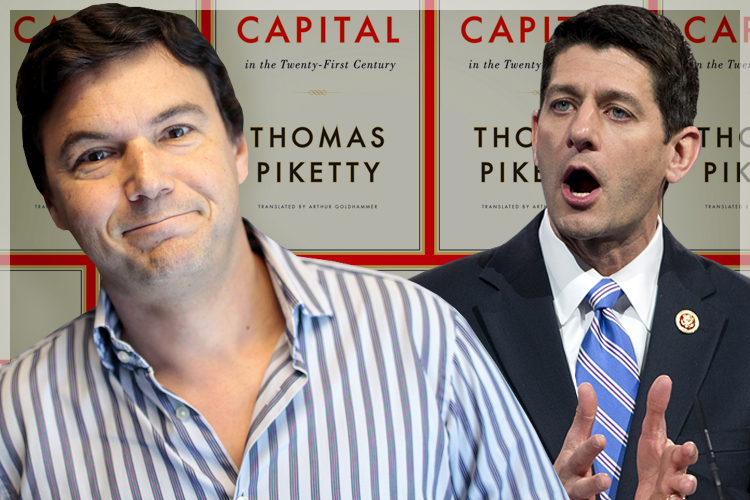
Thomas Piketty terrifies Paul Ryan (Credit: Reuters/Charles Platiau/AP/Manuel Balce Ceneta/Salon)
Five years post-collapse, Piketty and Elizabeth Warren offer a way ahead. That's why the right must destroy them.
Paul Rosenberg, SalonThomas Piketty’s “Capital in the 21st Century” hit No. 1 at Amazon, right around the time that Elizabeth Warren released her book “A Fighting Chance.” Far from being the only figures addressing the failure of unregulated market capitalism to produce fair outcomes and broad prosperity, they embody two key facets of that criticism: the intellectual/academic and pragmatic/political. But there are a host of other figures criticizing the workings of actually existing capitalism and the increasingly destructive inequalities of wealth we see it producing all around us.
It may have taken more than five years since the financial crisis hit in late 2008, but are we finally seeing signs of a coherent response coming together? A number of recent developments suggest that we are. Just in the last few weeks, for example, another hot new book is “Flash Boys,” the latest from Michael Lewis on the most recent form of mass-scamming on Wall Street, and there’s new attention being drawn to the work of Martin Gilens demonstrating the power of elite control of our political system. His book “Affluence and Influence: Economic Inequality and Political Power in America” was an award-winner in political science last year, but his follow-up study with Benjamin I. Page, the essay “Testing Theories of American Politics: Elites, Interest Groups, and Average Citizens,” has touched a broader nerve, with stories at the New Yorker, Huffington Post, and by Michael Lind here at Salon, among others, with added notice on cable TV. And of course, Pope Francis keeps mouthing off against inequality, too (which routinely causes Paul Ryan to comically insist – almost Stephen Colbert-style – that the pope is actually inveighing against the welfare state).
What makes Piketty and Warren stand out, in particular, is that real change needs both a framework of shared knowledge and possibility — which Piketty’s vast store of data helps provide — and exemplars of articulate, high-level struggle setting the terms of public debate, which is where Warren comes in.
This is not to say that Piketty’s work is something simply to rally around. That’s more of the pope’s territory. There is plenty to debate about Piketty’s work. But so far, criticism from the right has been ludicrous, while criticism from the left has been largely overlooked — a situation that must inevitably change if something is really to be done about inequality.
(More here.)



 Powered by Blogger
0 Comments:
Post a Comment
<< Home